Monday, September 21, 2015

The Vital Question: A Book Report

Nick Lane's The Vital Question: Energy, Evolution, and the Origins of Complex Life is not a book. It is an argument. It is an argument the way Charles Darwin's Origin of the Species is an argument. Nick Lane warns us in his forward, and some may not be ready to slog through this book.

Not that the book is that much of a slog, it's actually fairly well written and engaging, and he managed to mostly convince me with his arguments. He does keep the energy calculations to a minimum, but he is going to beat you about the head and shoulders with both data and supposition. So be forewarned.

Nick Bostrom, the Doomsday philosopher, will be pleased with this book. Bostrom really, really hopes that extraterrestrial intelligence (and by backwards inference, extraterrestrial life) is not found in the Universe. More locally, Bostrom hopes that absolutely no life is found on Mars, or Ganymede, or Europa, or Enceladas, or anywhere else in the Solar System. And never was.

If life is not found, then it is probable that the Great Filter which apparently exists to wipe out Life, is in our past. In other words, given the Fermi Paradox, that the universe seems set up to produce our kind of life, and that once it gets going our kind of life probably is set up to produce intelligent life, then we should be up to our armpits in aliens. We are not. "Where are they?" asked Fermi.

"Dead!" says Bostrom, "or even better still, Never Made It As Far As Us!"

So, Nick Lane makes a good case for No Complex Life. And by No Complex Life, he really means, no multicellular life, which in turn means no eukaryotic life, but maybe, probably, our kind Life elsewhere in the universe. Just not complex life.

Lots and lots of planets - once you eliminate the promising but barren earth like extrasolar candidates of which there are probably a shitload - probably have bacteria on them, and that's it. Bacteria, and archaea, forever and ever, amen.

(My own guess, and since we have a sample space of one to go from, is that there are perhaps only 1 out of 1027 worlds like Earth within the particle horizon of the Universe, meaning there is exactly one Earthlike planet that we can observe. That might placate Bostrom, but I doubt it. I know it bums out scifi fans hoping for aliens, but, hey, kids gotta grow up sometime).


Lane has done a very good job of convincing me that Earth life  - cellular life - got it's start in alkaline hydrothermal vents at the bottom of oceans. I used to think life got its start in black smokers, but that is a bit too extreme of an environment.


But alkaline hydrothermal vents, with just the right chemistries, with a similarity between and high Ph cell interior and low Ph sea water, along with iron/sulfur catalysts that are at the heart of practically every nanomechanical respiration mechanism that cells possess, just looks too right not to be true.

All that needs to be done is to set up a working experiment that demonstrates it, rather like Miller's and Urey's lightning-in-a-bottle that created amino acids. (Now,  pretty much a curiosity as evidence suggests early Earth's atmosphere looked nothing like the Miller/Urey experimental mix.

So, consider. Life did not appear in some warm pond. There was no primordial soup. Early Earth (and  early Venus, and early Mars) had an atmosphere of water vapor, CO2, and nitrogen, but very dense. All those artist's conceptions of early Mars' blue oceans are fantasy. Instead, picture what Venus looks like now, blanketed in murk, and that is the early Earth.

Consider: The faint young sun paradox. The sun was 30% as bright as it is now 4 billion years ago. And yet all rock evidence says Earth had water on it. Not a hellish lava Earth, and not a frozen solid Earth, as we would expect. Same with Venus. Same with Mars. But Venus and Mars never developed life. Why not? My guess is, no magnetic field. The early sun was hissing, spitting kitty cat of radiation and solar flares. Without a magnetic field to protect them, the sun stripped Venus and Mars of their atmospheric hydrogen, and they were doomed from the get-go. The sun was also pumping out huge volumes of UV radiation, not to mention all the planets getting pummeled with the leftovers of planetary formation. The only safe place to be is at the bottom of the ocean.

So, that's my argument. Life - as bacteria and archaea - got started down there, and it got started very, very quickly. So, given the cosmic abundances of chemicals that make up our kind of life, given the favorable thermodynamic properties of molecular formation that make our kind of life probable, one would expect a Universe full of (microbial) bugs.

Okay, fair enough. What about complex life? Eukarya? That is the scandal. As Lane argues, it probably happened only once, and it involved an archaean host and a bacterial enosymbiont. The bacterial component turned into what we call mitochondria, and the archean host swelled up into the giant chimeric monster of a cell we call eurkaryotes.

Kudos to Lin Margulis to pushing the argument for this insight of cells merging. But! The evidence suggests it only happened once. All the other stuff inside complex cells, the double-walled nucleus, the endoplasmic reticulum, the Golgi apparatus, the flexible cytoskeleton and flagella are NOT further symbiots absorbed. There is no evidence to suggest this.

Meaning, the origin of the eurkaryotes was a one-time freak accident. Oh, perhaps that's a bit of hyperbole, but not much. Meaning, probably all those buggy bacterial mat planets out there in the Cosmos, stay bacterial mat planets out in the Cosmos. Four billion years on, and they've made zero effort to improve themselves.

As Lane suggests, nothing is more conservative than a bacteria. The weird, monstrous, chimerical patchwork Frankenstein's monster which is us may just be a one-in-a-Cosmos shot.

All the more reason to be nice to other.

Sunday, September 20, 2015

Expo Chicago 2015

I went to Expo Chicago Saturday. There wasn't as much to take pictures of as in previous years. There were an inordinate amount of tall, stunning, blonde women, this year. Sorry, no pictures. Since I am neither rich nor famous, I was ignored, along with 99.999% of all the other males there.

Gallery Thomas Schulte of Berlin had some nice work by Allan McCullom. these very nice hand-turned objects were done in ash wood, A continuation of his Shapes Project. I was drawn to them both because of the wood and because they rather have a similarity to some of the shapes I play with, basically metazoan body plans. These shelves here go for a cool $108,000. The whole wall of twelve shelves can be had for $324,000. Allan had these turned on a lathe by craftsmen in Germany.

Cuban art was once again present with Cernuda Art gallery. Here is a painting by Manuel Mendive that I liked. I guess he's going for the whole alternate dimensional mechanical elves experience from the Santeria perspective.


James Turrell had not his normal stuff at Pace Galleries.


Bullethead, 1990
And welcome back, Donald Lipski! He has not exhibited for awhile. He has been doing mostly public commissions. I last saw his work at the Chicago Cultural Center in 2001. He had a piece at Hill Gallery of Birmingham, MI for an upcoming exhibition.


Saw a very fun kinetic piece by Carlos Costa at LOCAL Arte Contemporáneo (Chile).


Other than that, saw some art, some good, some hideous. I engaged in painful conservation with curators and gallery owners who would have much rather been talking to rich and famous people. Got mistaken for a gay guy and was hit on. Walked around way too much, and suffered for it later. Ended up in going to bed at 9:30 in the pm. Next up SOFA Chicago in November. Still not sure if I'll go to that.

Friday, September 18, 2015

No Shame In Fail

I was going to talk about food, but what with all the bleak news about how us ape-shaped bugs doing our best to make this planet uninhabitable for ape-shaped bugs, it's just too damn depressing.

So, using my best optimax formulae for deck chair rearrangement, which involves a certain amount of denial, I keep plugging away making art and submitting it. Here's the latest, and it's getting submitted to the Corning New Glass Review, which I never get in:

Machinerette Polyptych #1

This won't get in either, but, hey, it's not for lack of trying. This creation and submission would be considered in today's terminology a FAIL. It's a pity that this term, which pretty much applies to everyone and all circumstances, has entered into the snarky descent of the treadmill of pejoration.

There's nothing wrong with fail. In fact, I often tell my students "No shame in fail".

Case in point. Last night I used up my personal studio time to tutor a kid in the Design II class. Design II moves the students from two-dimensional works to three-dimensional, in preparation for the Sculpture. The sculpture professor teaches the class. He has basically had enough of this kid, and so he was handed off to me.

Look, I understand the sculpture professors dismissal of the kid. He's got his favorites, whom I call little poodles, and for whom art is effortless, or nearly so. They are easy to teach and they always follow the rules. He has little patience for the strugglies and problem children.

I get the strugglies. I get the broken toys. I get the problem children. I have no problem with that. The art they make is often awkward, clumsy, misshapen, deformed, disfigured.

Fantastic.

Always always far more interesting than the perfectly crafted and perfectly bland art that the poodles make. The rejected kids have a had time following the rules, often because the rules are incomprehensible to them.

So, this kid last night, obviously is within the autistic spectrum and also is tourettic with a profound verbal tic. But he's earnest, hard-working, wants desperately to get it, and is willing to put in whatever time and effort is necessary to get it.

Well, shit, I really had not choice but to see what I could do to help him.

He had been in the Design I class. I had been told by the instructor that he struggled in that class. A lot of the students in there were snickering at him, because he's weird and a retard. That kind of shit makes want to crack some skulls and get in some faces. But the nice story is, a girl in the class, a gorgeous stunning brilliant girl, stepped up to the plate, moved her stuff over to his table, provided him some support and companionship and silenced the snide little poodles.

Good on her!

This poor kid just didn't have the first idea of where to start. Two dimensional composition was hard for him. He can't understand basic spatial composition. He can't read a ruler. He doesn't understand what angles are. And the assignment is to create platonic solids from the cutouts on paper. So, anyway, I spent an hour and a half with him, tried about five different approaches to the problem. I had him ignore the instructions, gave him lots of paper, scissors, masking tape, the occasional timely advice, and said, make the solid as close as can, don't worry if it is exact, and have fun. Don't be afraid to make mistakes.

I had to some arithmetic for him, but I made him watch me do the work. I had to show how to work a protractor and compass, but he had to do it. Because we learn by doing. I wasn't going to strictly speaking doing the work for him.

"It's just pentagons and equilateral triangles. Just keep on cutting them and piecing them together", I said. I had him cut out each face and tape it together, and then I had him take it apart and lay it out as a contiguous piece on paper. And then draw it. Then cut that out and fold it, and tape it together. It was nice to see at the end of evening that he made kind of a fucked-up but recognizable icosidodecahedron.

"I think I'm starting to get it" he said.

Thursday, September 17, 2015

Orukter Amphibolos

We are still on food. Yes, we wonderful proton-powered collective metazoans needs us some foods!

Speaking of power, I didn't watch the Republican (master)debates last night, but I hear Trump slipped Jeb some skin.


Good thing they didn't fist bump, or their Wonder Tard Powers would have activated. And then what?


So, food. Again. Still. Probably for awhile. Hey, let's talk about Oliver Evans. I think in many respects, Oliver Evans kicked Leonardo DaVinci's ass when it came to inventions. True, Leonardo came with lots of unworkable and impractical inventions, a lot more than Evans, but unlike Leonardo, Evan's rubber always hit the road.

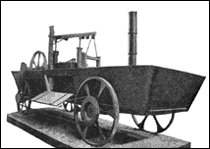
Oliver Evans, along with Richard Trevithick, came up with the high pressure steam engine.  Oliver Evans built the Orukter Amphibolos, the world's first automobile and the world's first amphibious vehicle. When he drove it through Philadelphia's Center Square in 1805, thousands gathered in amazement.

But much important a contribution was Evan's automatic flour mill, developed to fruition around 1789.
"He saw the method by which millers turned wheat into flour and he was disgusted by the crudity, waste, and dirtiness. A mill customarily employed four men and a 'hopper boy' to clean, grind, cool, sift, and pack. One strong man carried three-bushel sacks up ladder-like stairways and dumped the grain into cylindrical 'rolling screen' that freed the grain of its chaff and dirt. A boy raked the cleaned grain into a funnel or hopper leading to the second-floor millstones, driven by waterpower. The warm, moist, ground meal was packed into buckets and hoisted to the third floor. It was spread out on the floor to cool and dry. A third man pushed the dried meal into a vertical chute. Gravity carried it into cylinder covered in bolting cloth. Once sieved, the flour fell into a chest and a fourth man  shoveled it out into barrels. In all this labor, dust was raised, grain was trampled underfoot, and the flour quality was very mixed."*   
"Mixed" was an understatement, the flour typically had manure, insects, offal, trash, and any number of other very undesirable things embedded within it. Aside from the amount eaten by vermin, most of it spoiled before it could make it to market - where it was used anyway.

Evans' ingenious automatic integrated production line used one man, doing the work of, who could process 300 bushels an hour. In addition, the raw gain emerged as smooth flour untouched by human hand, devoid of hopper dust, footmarks or insects. Footmarks, in case you haven't figured it, was anything that became attached from the incredibly filthy mill dirt and mud of the mill yards.

His process was promptly denigrated as "a set of rattle-traps, and also shamelessly ripped off by millers up and down the Eastern seaboard, and it was not until Congress passed an act for the Relief of Oliver Evans, signed into law by President Jefferson in 1808, that he was able to receive partial recompense. As usual, as is such the case of so much of capitalism in America, his inventions were "stolen fair and square". From the monies recovered, he founded the Mars Works west of Pittsburgh, continuing to manufacture steam engines until his death. The steam engine was something for sure. But, more importantly, there is little doubt that Americans, eating flour milled by Evans' mills, were more likely to live to tell the tale, and certainly had an impact in being able to reproduce at "biological maximum", and spread westward ho.

*From They Made America, by Harold Evans with Gail Buckland and David Lefer


Tuesday, September 15, 2015

The Scale Of Government Is Not Invariant

(Or more generally, organizations are not fractals).

Napoleon is a dickless asshole. Literally.

You may recall in yesterday's essay I called Steve Jobs a dickless asshole. Jobs used this term of disparagement all the time, so it stands to reason that he found it hurtful in the extreme. It follows we as a society should make an attempt that he should forever after be known as a dickless asshole. Nothing really wrong with that, considering how powerful the asshole niche is within the society of us ape-shaped bugs, and for that matter, how it seems to be a near cosmic rule in organizations. I would hazard to guess that if we ever meet space-faring aliens, they have good representative asshole niche - unless they've managed to find a way to be both effective and nice.

Napoleon really is a dickless asshole though. During his autopsy, the doctor removed some souvenirs, and so his dick meandered through that grisly subset of the global commodities market known as reliquaries until settling in New Jersey. Cosmic irony would have dictated that it reside next to a jar filled with Rasputin's cock, but no. I guess.

Anyway, what the fuck am I talking about? I went back and read yesterday's essay, and I had to ask "Kurman? Was there a fucking point to any of that?" I think there was, is, but it's gonna take a while for it all to cohere  - or congeal - into something. I think it has to do with big picture items and long term trends. But honestly, I'm pretty sure that the general anesthesia from two weeks ago scraped a good 10 IQ points of my brain, and maybe permanently. Add that to the other four operations going under, and the ten concussions I've suffered, and I suspect one more trial under the knife, or one more conk on the noggin, and all I'll be able to type is "Meow".
Ferguson

(Oh, and that ape-shaped bug crack? Not really meant as insult, more a realistic observation of our place in the larger universe. And whether "bug" refers to Ecdysozoa or Eubacteria really doesn't matter as both have admirably solved 99.999% of the survival problem and are worthy of emulation).

So I suppose one of the themes from yesterday was about energy, but the stress was not necessarily upon our most recent sources - oil, gas, coal, nuclear - that have allowed the big accelerating anomaly our species has undergone lo these past three centuries, but rather the much more important energy source known as food.

Food, baby, food!

Any long term trend, any big picture item must treat this as the salient of all discussions. True, oil, gas, and coal, have opened up new venues and ventures to our species, but in many respects, all they've really done is added a turbocharged hemi to an already very sleek and stylish automobile - that incredible robust time-tested might-as-well-be-Promethean-nanotechnology we call eukarya in human form (and of course the holobiontic menagerie that surrounds and contains us like that hokey wizarding Force in those hokey Star Wars movies).

And if we are to talk of, to bump it up a category, Life, then we must talk of organization, networks, whether communal or parasitic, swarm or dissipative structure, centralized or distributed, fractal or Pareto dispersed.

(One quick aside about food, and another dickless asshole known as Putin. Jared Diamond's scholarship in Guns, Germs, and Steel may be slipshod, loose, and sloppy, and he may accused of geographic fatalism, but he does have a point about food zones. Longitudinal (east-west) food zones are preferable to latitudinal (north-south) food zones for propagation of staples, but in a world of climate change - assuming that favorable conditions travel to the poles, and this is a coarse assumption - the food zones will not travel with them. Latitudinal food zones (ignoring storm, flood  and drought) are to be preferred. Which means the Ukraine is fucked as a food zone, and Russia as well. Putin is wasting his time. The fact that got he caught with his pants down by failing to move most of Russia's arms-making capacity out of the Ukraine shows him to be a short-sighted fool, rather the strong manly chess master American conservatives so desperately whank off to).

So, political organizations (and, for that matter business organizations, which are based upon centrally planned dictatorships). What we know is basically every form has been tried and found wanting, but some forms are worse than others. Confederations, for example, don't work. In America, they have tried twice, and both have been dismal, utter failures. Anarchy, for that matter, I don't think has even ever been tried, as it is contrary to the very idea of organization and principles of networks of social creatures. Grover Norquist, clueless - and possibly dickless - asshole, mischaracterized Burning Man as a self-organizing anarchic emergent community when it was nothing of the kind. Burning Man was - is -  a highly regulated, highly policed, luxuriously subsidized annual expedition to the South Pole - but without the death and cannibalism and frostbite and gangrene.

So then the question is granularity of control. I for one prefer Big Government because it's so big and monitoring (at least historically) so remote and lax that it was easy to get away with a lot of shit, and still get a lot of free stuff for free from the taxpayer.

(I have to admit, my views of governance are moving away from the Lockean social contract theory, and heading more towards the Serresian layered mutual abuse social parasitism theory, and more on that later maybe).

But let's get back to that idea of layers of categorical filters and control points. The American Founding Fathers, perhaps swinging the pendulum too far the other way after being subjected to the parasitic abuse of the jolly olde British Empire (ignoring their own parasitic land theft and security needs against the dreadful Savage which said empire supplied in return). Even when the United States in Congress Assembled proved to be wholly unworkable, members of the Constitutional Congress were still staining their pants so badly over the return of tyranny that they much preferred the idea of state and, more importantly, local control.

Problem is, local government can be the most stringent dictatorship of all (and as such, is NOT the modern system of government per Foucault's observations on the panopticon). I mean, I much prefer that the government be way the hell over their in Washington DC, with layers and layers and layers of bureaucracy distancing them from me, and all the silly little incestuous CEO-type buttheads stuck in one little easily nuked enclave. True, their are always exceptions to the rule. True, technology is changing so rapidly that the monitoring points are getting closer and closer into my business and privacy, but this is the cost of being a social creature. And besides, monitoring and control technology is part and parcel of the involving arms race of deceit, which I consider a lot more fun than the usual idea of arms race.

Monday, September 14, 2015

The Spine of the S Curve

We are told that for every one person living, there are fifteen ghosts floating around. If you start at around 50,000 BCE, that puts the total number of dead people preceding our current 7 billion at around 107 billion or so.

You ever think there will ever be 107 billion people living at some point in the future? I doubt it, and if they are, they'll be infesting the solar system rather than Earth in some Kardashev level 1.4 (some 10 to the 22nd power watts to play with, if my math is right) civilization. And I also doubt you would strictly call them people, or at least, not people in ape form. And maybe not even in a watery carbon substrate.

Funny thing, or not so funny thing is, where do get the cheap energy for all those people? Well, that's the not the problem is it? It's cheap energy density that is the problem, the same way that lake or a river is good for waterwheels, but a narrow channel is much, much better.

Consider how we get by with just coal, oil, and gas. All those little archea and bacteria, laying down near teraton geologic deposits of rock and shale and carbon and all good stuff, their ghostly little selves outnumbering present populations some 20-30 to 1, means there is just a shitload of gas, coal, and oil still available. And that's not really the problem, to get an appropriate energy density to be useful, extraction has to stay below some constraint.

That's really not the problem is it? Food is the problem. Last I checked, food needs soil, air and water, and that's about it. Oh, it need a little bit more than that, but that's still far more worrisome and sophisticated a task than simply drowning in your own shit and floating to the bottom of the sea to be covered up by sediment and turned into more or less pure carbon.  


Because when you think about it, the whole system of food, which is to say the geologic environment, plus bacteria and archea, plus eukarya in the form of plants and animals, all of it based on a universal chemical dance of proton gradient and redox replenishment that makes our current best energy density look like pathetic little weenie sparks (seriously, the electric potential across a 6 nanometer mitochondrial  membrane is like 400 million volts!), and the machinery to do it, makes even our most sophisticated machine look like a cumbersome tinkertoy. And all of it done through a incredibly massive parallelism and natural selection. Why, the whole of human civilization kind of pales in comparison. No wonder the godbotherers have a hard time dropping the silly Intelligent Design argument.

Yeah, okay what's the point? You can talk about the Industrial Revolution, and I sure do agree it's a nontrivial event. But the agricultural revolution, plus the conquest of the New World ("Pangea stitch'd together again), plus good 'ol poison gas Fritz Haber, plus Norman Borlaug, and countless other experimentalists and organizations, gets you all the riches that power all the little self-replicating robots in ape form, that can take oil, gas, coal, even nukes and add only a slight addition to the actual energy budget that we enjoy and allows us to watch all our little TVs and drive our little cars and drink our little drinks and smoke our little smokes, and build our little cyberspaces, and launch our little probes out into outer space. And the really interesting thing is how all this seemingly intelligent shit, writ large as emergent global behaviors, is still not much smarter than the dumbest microbes.
Population growth of dumb things like us

America and the Soviet Union: two crabs on a beach. John Rockefeller and Standard Oil: a phagocytic amoeba. The dickless asshole Steve Jobs and Apple: an anaerobic flagellated protozoan parasite.

Come to think of it, isn't life just parasitizing the Earth? And ain't we all glad Earth is kind to have a magnetic field?

And it pretty much starts, I think, just to throw a date out there, around 1700CE. I pick that date, because (if we are lucky, and I am optimistic, and the period going forward towards, say, 2200CE or so is the spine of the S curve), that's the beginning of the Anthropocene, and everything before then pretty much looks the same. Meaning, if someone like Mark Twain, author of Connecticut Yankee in King Arthur's Court (and if there is anyone who should be allowed to time travel, it's Twain), were to start in 1700, and we send him back one hundred years at a time, there's not much that is different, noticeable different. But send him forward, and things start to happen!

1800, maybe not so much, certainly improvement in our capacity to slaughter each other, 1900, for sure differences, but still recognizable to him. But 2000? Oh, the houses and streets still the same, and he able to understand most new technology. But 2100? 2200? Oh my!

I am being optimistic. And maybe I'm underestimating Twain.

Saturday, September 5, 2015

The Walking Cure

People emigrating from Europe to America, I would assume, if they had a choice, would settle in regions most similar to those they left. There were constraints of course: available land, available work, the whims and needs of the bosses. My ancestors, coming in just after the Civil War, were the cheap peoples Europe exported in exchange for cheap food from America.

The area my ancestors settled, Northern Indiana, strikingly resembles the Northern Plains of Germany. More specifically, Northwest Indiana, so I am told, very much resembles the current Federal State of Mecklenberg-Vorpommern, the "Florida of Germany", if you can believe that. My part of Indiana is called The Region, or more colorfully, the Armpit of Indiana due to all the industry.

True, great-great-grand-daddy's country of origin is listed as Prussia (and the joke is when asked of our nationality we say "Prussian-Norwegian, drunk and crazy!"  - or  - "doubly psychotic!"), but we are from Mecklenberg. Lake country. Deep glacial lakes with sandy bottoms, clay-loess sandy soil, thick dark forests, the smell of a large tract of water nearby.

(The lesser coat of arms of Mecklenberg has a bull, but I always thought it a laughing cow with a crown).

(My mother's side of the family - hill people from Norway, and not so fortunate - ended up half in Chicago and half in Minnesota - lots of Hills in Minnesota - and doubtless had they their preference would have ended up in Vancouver or Seattle).

Not so sure dad's side of the family was actually from Mecklenberg originally. When I hitchhiked Europe at the age of 19, I was pretty much topped-up full of stupid. I did managed to notice that I wanted to spend almost all of my time on the island on the island of Zealand, where Copenhagen is. It felt like home. The Danes, despite owning a peninsula, are really an island folk. And I enjoy island life.

I did not visit Mecklenberg when I was there. It was behind the Iron Curtain in Eastern Germany, and Amsterdam beckoned as a more choice destination.

I've a cold. Coughing, after surgery, especially abdominal surgery, with strains already placed upon the diaphragm, you would think would be agony. Well, yeah, kinda, but actually no.

The fever and general muscle ache is no fun, and last night was the worst, with me waking up to a soaking wet bed. But today, thunderstorms in the morning, I lay about in fresh sheets and dozed. Finally, I got up and said I have to at least try to walk.

(Eating? Not so much fun. Whatever opiates and other drugs they gave me have left a persistent bitter taste in the lower back corners of my jaw. Sugars are out of the question. Salt acceptable, and sour tastes the least objectionable. But I can tell you, like a dog given bowl of brandy, I have absolutely NO desire for intoxicants of any kind. I wish strenuous physical activity. Out of the question for a few weeks according to medical opinion).

So, I went for a walk after the storms. Sun was out, humidity up there, I went past a new city park being converted back to wetlands. Sweat popping on my brow and UV on the skin felt pretty goddamn good. But best off all were the swampland smells. Hard to describe. Again, a sweetness that the lungs appreciate more the nose, but I also detected smell of hod-hewn clay. That was a smell back of earliest childhood, gardening in the backyard, the faint organics of broken up clay, released from when last the glaciers deposited it in its inorganic mineral matrix.

The walk did me good. Feel pretty good now. I'd say the smells helped as much as the walk.