Wednesday, October 15, 2014

Done Run Out of Luck

The client pieces I was commissioned to cast are done. Right about one third of the way in to casting last weekend, my lance pyrometer decided to die. I had to gauge the temperature of the bronze by eye. Considering they all cast fairly OK, I have to chalk it up to being lucky.

There are two conceptions of luck, or maybe five.

One is that luck is random contingency, and as such is probably infinite in expanse. Given that, some would argue that it's application is random, and thus there is no correlation between lucky events. Others suggest that there may be a correlation, in which case lucky events stick together, and if you are experiencing luck, best to ride out the streak and score as much as you can. In other words, if things are working out for you, best to buy that lottery ticket.

The other view is that luck is a finite commodity. This could mean that the views of its application are similar to above (either no or some correlation). I view it as, more like a Pareto distribution, in which case the events tend to congregate towards the prosaic, but one cannot ignore the fat tails of luck inhabited by black swans and dragon kings. If, as I suspect, ordinary events are the more common (more things can go wrong than can go right), then luck can be used up. I know this doesn't make much sense, but it's pragmatic principle. If I've lucked out on something, I'm unlikely  to push the envelope and buy that lottery ticket.

So, anyway, I got lucky casting these things, with a minimum amount of casting defects. Two of the pieces used all the 48 pounds of metal in the crucible. One of the big ones, I poured the bronze just a tad too hot (which I could tell once we started pouring into the mold). That too hot piece I took outside into the pouring rain, and then hosed it down. (The idea being that there was a good chance the piece would not cool down fast enough and a shrink porosity defect would occur). The amount of steam was such that a good twenty foot cloud appeared, and we could have attacked an ISIS position with such cover.

As it was, I did indeed have a defect in the piece, a heat tear in some interior detail.

"Well, maybe he (the client) will like that defect" rationalized my student aide.

"Yeah, if he likes his babies with birth defects, sure" I replied.

I have noticed my tennis elbow (and left hand) have been complaining a lot. I've been soaking my left arm in ice at night, and helps, but my suspicion is the lifelong damage is there to stay, and I just have to work through the pain. And work I must do, as these metal pieces will not fix/pretty up themselves.

Here's some pics.
Figures rigged with my critters tagging along
 My rule for rigging which I must constantly remind myself: ABV! (Always Be Venting)
Pieces with ceramic shell on them
 I would have you notice that the two hands have slightly different but similar rigging, and one ended up with a shrink porosity defect. I attribute this to not keeping the runners equidistant with respect to the thickness of the piece.
Rigging is more art than science
 I gambled the amount of metal left in the crucible would fill the mold, and lost...
Oops. Gotta fix that hole.
 My hands ache like you would not believe, so I take break.
Grinding with air die tools
 It's getting harder and harder to grind/fettle/sand/file/chase stuff clean and not feel it for days afterwards.
Hole in hand welded up, ground down

I'm 60 in three years. I don't know if my tendonitis will go away,or if my body will hold together.  I dread not being able to do this anymore. Dread is too weak a word. I can't imagine not doing this.

Monday, October 13, 2014

West of the Revolution: A Book Report

West of The Revolution, by Claudio Saunt. This book takes place circa 1776, in places on the North American continent besides the English Colonies. It explores the conditions that existed beyond our parochial little world view. Like the book Empires, Nations and Families, by Anne F. Hyde, Saunt covers the real history of the Continent, the real powers that governed and ruled within America. Hyde's narrative takes place during the period 1804-1860 or so. Saunt limits himself to the decade of the Revolution, and of course, the First World War, otherwise known as the Severn Years War, or the French and Indian war. The decisions concerning the partitioning of the North American continent along the Mississippi river resonate down to this day, but not due to decisions made in the peace treaty in Paris, rather how those decisions were taken advantage of by American Indians.

As Thomas Jefferson put it, after he entertained the Osage chiefs in Washington DC, "The truth is, the Osages are the Great Nation south of the Missouri. Among them we must stand well, because in their quarter we are miserably weak".

About a month ago, Jonathan Chait wrote an essay called "A Southern GOP Can't Be the Party of Lincoln" detailing the North/South split of our country that started prior to the Revolution, and festers down to this day. He lays out how the Republican party is essentially now the party of the Confederacy. David Brin picked up on the theme, and riffed his own take on this ongoing  event of the divide along the Mason-Dixon line.

A fairly interesting and worthwhile investigation, this examination of the North/South cultural divide within America, but it misses the far more interesting East/West divide. More to the point, the cultural difference between North and South are for the most part trivial. Both were interested in conquering and exploiting the continent west of the Appalachians, and later, west of the Mississippi.

While elites of the South would have preferred a vision of of a continental realm of landed gentry and hereditary rule, patterned on jolly England, the North was willing to eschew titles and pomp, but keep the mercantile power. Both the North and the South were all about cheap labor, their visions differed only slightly. While the South opted for the idea of chattel slavery, the North preferred trading cheap food for cheap people. Both wanted to exploit labor and ingenuity of peoples to the optimum value they could wrest from them. And why not? Labor was the only sticking point, getting people to do all the work for you, as everything else was practically free, no? That was the colonial vision of lands west: a world with no history, populated by peoples of no consequence.

So it is worthwhile to understand exactly what was going down outside of a tiny feeble set of English colonies clutching to the Eastern seaboard. In fact, I'm going to reproduce a striking map found in Saunt's book. Here we see the populated areas of the American colonies free of geopolitical symbolic borders.

Courtesy of West of the Revolution by Claudio Saunt
Looks a lot like a bad case of black mold ready for some chlorine bleach, doesn't it? And honestly, had native peoples west and south had any idea what was going to happen to them over the next two hundred years, I'm sure they would have applied a generous hosing down of bleach to rid the continent of this invasive species.

(And spare me the "those Stone Age slow learners didn't stand a chance against our superior technology" line. That's a trope that needs to die. Indians consistently and successfully bested and slaughtered European-style armies through and beyond colonial times. If you look at the map, English colonists had after almost two hundred years only made in ways into the Continent of only three weeks traveling time by foot. For every one surviving colonist, ten were sent from England, an attrition rate that few nations would find acceptable today. One of the single worst defeat, to this day, of the United States Army is the Battle of a Thousand Slain in Ohio country in 1791).

Our (America's) only advantage, aside from the fact that we Europeans are a miserably filthy and disgustingly germ-ridden race, is that we were able to reproduce at something close to biological maximum. Certainly this could not have occurred in Europe, and especially Northern Europe, without the advantage of the new food crops available through the Columbian exchange. Nor could we, as a nation, have thrived without two of the largest welfare programs ever conceived: the Louisiana Purchase, and the Homestead Acts. If any stupid fat white old conservative man should bother you about how superior they are due to innate white abilities, and how they could have been successful without a single penny of government monies, I suggest you spit and laugh in that parasite's face. Those soft squishy leeches make the fictional Cadillac driving welfare queen look like a paragon of Working Class Pride. They have not the slightest clue as to how they have been coddled and pampered by government largess and the coincidence of history. Capitalism was subsidized by the treasures of the New World. Do not confuse any supposed inherent systemic superiority for sheer dumb stupid Luck.

Okay, sorry for drifting. The book covers most of the continent outside of the Revolution, and contains may fascinating details.

We learn how Russians conduct trade among the Aleuts: kill some, take others hostage, demand the natives hunt sea otters or they kill the hostages, then give them trinkets after they've hunted enough for them (which the Russians are ineptly incapable of doing, hunting sea otters by the way).

We learn how the Spanish had at best two paltry fingers of colonization sticking up into the continental United Staes: Santa Fe, and maybe San Diego. But the whole enterprise was pretty damn pathetic for the longest time, and they relied heavily upon the charity of Indians.

(In fact, this is a common them for early western US history: the people that head west rely heavily upon native american charity and the largesse of the Federal government).

We learn how the Lakota from Minnesota discovered the Black Hills in 1776. The great thing about the Black Hills is, since they stick above the prairie, they trap rain. The area around the Black Hills stays rich and verdant even when the rest of the Great Plains are bone dry.

We learn how, had the Creek been assisted by the stupid short-sighted Spaniards, the South may never have risen. We also learn how, had the Creek become purveyors of goods to the fastest growing slave colony of Georgia, they may have had a considerable economic clout, and perhaps could have avoided being booted off their lands in the 1830s. (In fact, had the Indians been willing to trade with the British rather than the Spanish in Cuba, I rather suspect Indian regiments would have served the South in the Civil War).

We learn most especially just how poisonous were the attitudes of the Founding Fathers toward Indians west of the Appalachians, how they were at best seen as impediments, and at worse vermin to be wiped at the earliest opportunity.

Most especially, we learn how fur was, for the longest time, more precious than gold. Because, quite simply Fashion is at least a 200,000 year old industry, back when we first started clothing ourselves, and for the longest time, clothes were our most important technology.

When you look at a map of languages and cultures of the United States of America, you will see that ancient America is still here, despite out best efforts to wipe it all out. There may come a day when the East/West divide becomes far more important than the North/South.


Wednesday, September 24, 2014

(Temporary) Good News For Food-Powered Robots

Grain and cereal staples are having another bumper crop. Corn and soya bean (soya bean, that's so cute) yields are out the roof. Good news for you starch and meat eaters (and yes, I have been experiencing sticker shock in my meat buying), not to mention you high fructose corn syrup sugary drink and candy consumer types. Bad news for food rioters.

Problem is, I prefer other things. Coffee, chocolate, herbs, spices*

This past summer, I got hold of some farm stand blueberries from Michigan. They were superb. Later, I had some really tiny, super-sweet strawberries we call Louisiana strawberries. After that, I had a hankering for some more. I bought blueberries grown in California and Florida, and I might as well have been eating plastic. Ditto the supermarket strawberries.

This is why, I think I have decided to become a fan of Slow Food. Slow food should be more properly called Endangered Food. I know the Food Movement has been around for awhile, most prominently cheered on by the likes of Michael Pollan, and I think it is time we recognize that cheap food - industrial food - is not cheap at all. And it pretty much sucks.


*Basically almost everything on my "Things I Will Miss After The Apocalypse" list, which I saw on a planting table in a dream I had wherein I had built a greenhouse in Iceland. I grew cocoa trees in it, and other fun things and their were birds of many colors living among the plants. A Dutch guy in a pilgrim suit invaded the greenhouse, broke the glass, let in the cold glacial winds, and he clubbed the last remaining dodo to death. Huh.

Monday, September 22, 2014

Expo Chicago 2014

I attended the event yesterday, Sunday. As usual, the people were more interesting than the art. Quite a cast of characters there, including one guy as thick as the Hulk, and wearing what looked like an theatrical asbestos fire curtain cut into a suit. The suit looked to be an inch thick and the guy was sweating like crazy. Oh, and I guess skinny fire engine red pants and high-heeled boots are the in thing amongst the gays and hipsters.

The art was, eh, well, play it safe for the masses type of art. A lot of pastel paintings. A lot of established artists. A LOT of flat screen TVs with fancy frames around them. As such the images were mostly static, and only a few were animated to take advantage of the TV.

I kind of wished I had brought in a dongle and a TV remote, and switched the paintings over to the Broncos vs. Seahawks game. I wonder how that would have gone down?

I also was at a booth that had a unattended tackle box open to a sheet stack of red dots. (Red dots are stickers placed next to works of art indicating they have been sold). I could have wreaked havoc and messed with heads had I stolen a sheet of red dots and visited gallery booths. Good thing I'm not evil.

Speaking of red dots, here's pics of works that I saw sold. First off was William Villalongo of Susan Inglett Gallery. William sold two nymphs.


He does some fun stuff with paper collage.

Cernuda Arte did quite well with four paintings sold.

This was a work done by the late Wifredo Lam.

This was a painting done by Miguel Florido.

Cuban art was a go this year. Not sure why. Local patrons I suppose...

John Malkovich teamed up with Sandro Miller to recreate famous photographs.  See this article.  These works will be on display at Catherine Edelman Gallery next month. When I saw this photo, I said to myself, that is one ugly broad:


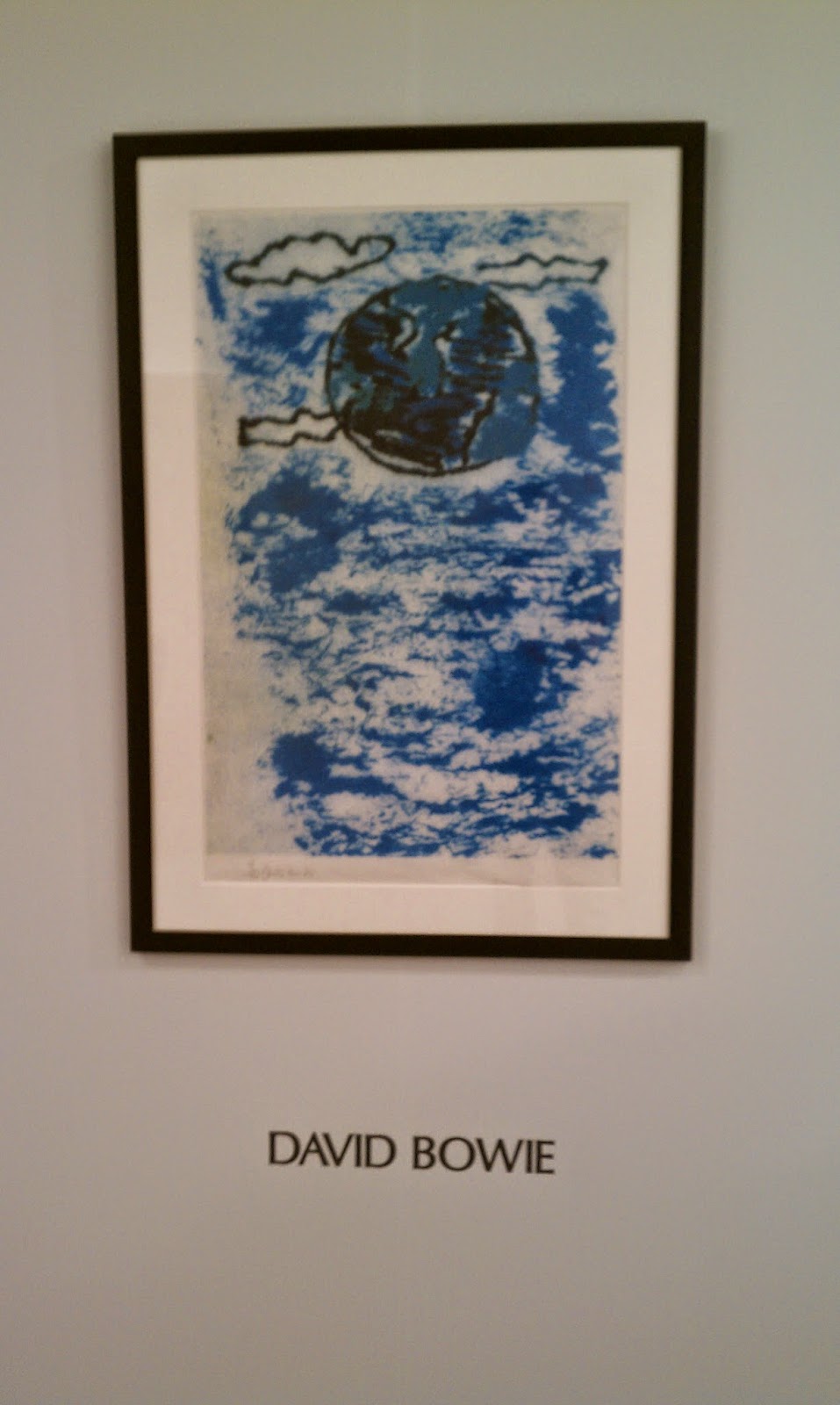
David Bowie has an exhibition at Museum of Contemporary Art. He had some silkscreen prints up:


And here is other stuff I saw that caught my eye...

(Courtesy Edelman Gallery, this one needs explaining, stacked negatives that pictures don't do justice to)

Francisco (Paco) Esnayra

Sorry, don't have info


Friday, September 19, 2014

How It's Made: The Lost Wax Process From Start To Finish

Last year I did a Kickstarter project to cast waxes. Part of the plea was to produce a video that showed how the little bronze trinket rewards were made using the lost wax process. I thought the video was gone forever, as I had deleted it off my computer for some reason. Sorting through various thumb drives, I found a copy of it. I posted the video to youtube, and here it is...

Tuesday, September 16, 2014

Stuck In The 70s

Back in August of 1996, I was driving cross country back from Seattle to Chicago. I stopped in Osseo, Wisconsin for lunch at the Norske Nook. I had meat loaf, mashed potatoes, peas and carrots, and then a big piece of blueberry pie with vanilla ice cream.

Needless to say, what with this gut bomb in me, basically a thorium reactor in my belly, I started to get sleepy on I-90. Round about near the Tomah rest stop, a driver in a car next to me honked his horn and woke me up out of a probably several second slumber. That realization sent a surge of adrenaline through my system that allowed me to pull into a rest stop to get a nap.

But I've often wondered if I didn't die that day.

In which case, all this, the near twenty years duration since then, is perhaps a delusional afterlife experience, and hopefully some Helpers will be by soon to tell me I'm dead, and it is time to move on into the larger universe.

Or perhaps this is all some compressed relativistic death experience, and only a few seconds have passed since I crashed my car in '96, and this is the experience my brain goes through: the neurons suffer screaming oxygen deprivation as the blood pirouettes out of my severed head, which rolls on down I-90 next to other pieces of me.

It's not that I have any eldritch suspicions about this, it's just that that is a memory etched in my mind that is a signpost for a very different counterfactual outcome. One in which I do not exist, and you, dear reader, are not reading this.

And, if such strange thing can happen to individuals, can it happen to nations, or worlds?

Could it be that, in the same way I'm a little bit stuck in 1996, that the US of A is stuck in the 1970s?

Doesn't it feel that way? I'm told the zenith of western civilization was 1978. (I'm not entirely sure about that, as the physical convergence of the cheeseburger, french fries, and chocolate malted first occurred in a Chicago Walgreen's in 1926, so...)

But it could be that that was that, and everything has been just a mass hallucination since then?

Dude, the colors!

Thursday, September 11, 2014

Back to Wax Working

I've a commission to make five molds for a sculptor who works primarily in clay. He handed over his ceramic pieces for me to mold in silicon rubber with plaster mother molds. If he is happy, I'll makes waxes from the molds and cast them for him, and then cast bronzes for the wax.

The deadline is end of October because these pieces will end up in Sofa Chicago (Sculptural Objects and Functional Art).

In my spare time, I'm back to making waxes which I plan to throw into the mix of casting his pieces. So far, just doodles, really.

Making this one made me stupid happy like a twelve-year-old. I call it "Space Tick Waffle Saucer".

I also made three small bronze machinerettes for my brother for this birthday...