Tuesday, March 13, 2012

Computational Politics

The weather is warming up and so I am full on into running again. Funny thing about running is it is probably the closest I will ever get to meditation.

I've tried meditation, and all that happens I end up internally shouting at the little voice in my head to SHUT THE FUCK UP. Which is ironic, since its the little voice that is telling itself to shut the fuck up.

But running, if I run really hard and get myself to suffering so that the only thing I can even think of doing is drawing breath, well, that's the best way to get the little voice to shut the fuck up.

So the point of the meditation is get your conscious self to give it a rest, and let the whole series of unconscious, and deeper level autonomic mental functions do their thing unhindered.

Funny, though, how we are ready to trust all of these automated heurisitics within us, and have a deep and  abiding distrust for the machines in our society to do the same thing.

Such is the tone of this Financial Times article, School For Quants. These UCL kiddies are working on the economic and social Frankenstein monsters of the future - computational economics and politics: algorithmic trading, and soon, algorithmic trending, in the form of SocialSTREAM and other large scale cultural analysis engines.

Apparently the existing chaos and volatility in the financial markets are not a concern, rather:
"People say about algorithmic trading 'They're just a bunch of cowboys, you know'. Treleaven shook his head. 'No', he said 'It is industrialization. It is like putting robots in car factories'".
So, if that's all it is, why should we worry about the automation of human relationships?

Well you know, it took awhile for evolution to iron out most of the bugs in this kluge of a brain I possess, should I not be patient with the cute little earnest quants as well? They may be deluding themselves. It may be quite the Sisyphean task in store for these Young Frankensteins.

But, to paraphrase Albert Camus, "One must imagine Frankenstein happy".

Monday, March 12, 2012

The Smokemakers

Since the beginning of the year, I've been rejected by every juried art show that I have entered. When you consider that the average entry fee is about $40, that's a lot of wasted cash. Ah, well, so, I finally got into a show, the 2012 Rockford Art Museum Midwestern Biennale.  The show was juried by Lisa Stone, curator of the Roger Brown Study Collection at the School of the Art Institute of Chicago. 

Way to go, Lisa, and way to go, Rockford!

Rockford accepted my work two years ago, so I must be on a roll there.

Here' s the entry that got me in, entitled The Smokermakers.


The Smokemakers
Cast Bronze, approx. 16" x 12" x 6"

Friday, March 9, 2012

The Lost Colony of Texas

How to describe the span of 13,000 years in as many sentences, let alone a few paragraphs? It's an inhuman span of time, outside the realm of ordinary experience. There is no hook on which to hang a hat, so perhaps the best thing to do is describe those things that can survive so long: stones, stories, and people.

On the lost world of Texas, stones - and shards of pottery - can be found engraved with English words and letters. In "present day" Texas no one, not even scholars of ancient languages, can read them. For such is the constant mutability of language that even after a few centuries, someone using the South Midland dialect of North America circa 2010CE would be speaking gibberish - incomprehensible, but strangely disturbing in its familiarity.

Stories, oral traditions, have a surprising stability. The best known example on old Earth are the folk tales of Australian aborigines, separated from the rest of humanity for perhaps 45,000 years, four times as long as Texans. And Texans have their folk tales. There seem to be two branched origin tales. Both share the idea that Texans are not of their world, that they originally came from the stars.

The first set of myths and legends has it that the ancestors of Texans were gods up in the heavens, who over time bred and had children. But the offspring of the gods were weak and deformed, ugly and mortal. The gods, not being brutal, could not kill them, and so they left them there upon the earth, abandoned like a box of kittens on the side of a country road to fend as best they could.

The second set of myths has it that the ancestors of Texans were gods up in the heavens, who crafted the Texans out of mud and clay, and breathed a life and a soul into them. At first, the gods doted upon their children, and granted them their every fondest desire. But over time, the children became unruly, surly and ungrateful, and so the gods cast them down out of heaven, down to earth to fend for themselves.

Ethnologists who have studied both sets have surmised that the second set is based upon an older, more primitive narrative, as what archeological evidence that can be found does not support this conjecture.

(But imagine the surprise of archaeologists who, once the full scale colonization of their Moon was underway, having discovered the stash of records, technology, and mummified remains of the very first generation of wormhole pioneers, the determination that the very atoms of those ancestral mummies could not have originated in the Texan solar system).

What is common within the culture is the sense of abandonment, and an equal sense of resentment, and, paradoxically, pride in any technical accomplishment. Pride being the foremost characteristic of all folk tales. Humility is little found within the planetary culture, yet empty pretense is one of the foremost characteristics to poke fun at.

The concepts behind "All hat and no cattle" may be meaningless to the contemporary Texan, yet, if explain, he would readily embrace the phrase.

As to the contemporary Texan, viewed as a solitary individual, one who would have to say not uncomely, handsome in a rough and raggedy way, of large stature, robust, even beefy, but still retaining a surprising litheness.

This might be explain by both culture and environment. A love of strenuous activity and physical challenge is encouraged. And the native species of planet Texas do tend to be on the large side. The species analog of the wolf, for example, is the size of a lion. A lion as large as a grizzly bear. Bears are as large as rhinoceros. Bison as large as elephants. And elephants (or rather, mastodon, since the planet is a tad on the chilly side) as large as, well, mastodon. But that's big enough.

Albert Einstein tells us that my Now is not the same as your Now. We who inhabit the middles of things, in ordinary space, at casual walking velocities, at room temperatures, see things more like Sir Isaac Newton, who saw space and time as vast stage on which matter and energy played things out. His Now was the same Now as shared by everyone on that stage. Now, we know, not only is the same Now not shared within Einstein's relativistic frame of reference, but across the vast distances of the universe, with the indeterminancy of quantum mechanics, the passage of Nows varies. So, when you open a wormhole throat, the Now at the other end may be close to your Now, or a million years ahead or behind your now. For the fifty million people from Texas and its surrounds, who jumped through that wormhole, their Now got set back 13,000 years behind ours. This would be deeply troubling to Einstein, as it violates causality. But since this happens only through a wormhole, and this is expected, there's not much to be done about it.

Suffice to say, for the people of the new world of Texas, stranded some 60 million light years distant, some 13,000 years in the past, with perhaps the bare minimum seed corn needed to sustain a 21st century technology, and perhaps a billion person support shortfall, a Fall was inevitable. A series of tumbles at the very least. Fortunately, the level of technology on Texas never fell much past 1830s America. And, after a series of stumbles, but with a population growth at the biological maximum, with a culture fostering a healthy curiosity, they'd only five thousand years of relative barbarity to account for in Texan history. That left a good eight thousand years forward progress from a late 20th century level of technology.

You can imagine what happened. Peering through a peranoscope at Earth's own history, you find an average of about four thousand years to go from smelting iron to interstellar travel. Look through a similar peranoscope at the history of Texas - avoiding the usual Divergences involving nuclear armageddon, comet strikes, pandemics, etc. -  the Texans did okay.  

Rediscovering wormhole technologies, and doing Earth one better in coming up with a better than breakeven fusion technology (!), the Texans went on to colonize their whole galaxy. And as they worked their way up the technological plateau, heading further and further into our star-spanning, world-taming, cybernetic, mechanized, interconnected, informed, and hive-brained future, they still remained stubbornly human.

If what they went through in those five thousand years of our future could be called the Singularity, then it is interesting how they came out pretty much the same as when they went in.

Thursday, March 8, 2012

The Game of Monopoly

I've often wondered if there wasn't just a little subversive anti-capitalism woven into the game of Monopoly. If you look at the history of it's origins, it sure looks like it was set up to teach the lesson of how capitalism sucks for most everyone except for the privileged few, enriched by the many.

Why, even the railroad names seem to be chosen to reflect the enemies of the proletarian struggle for equality, during the Great Railroad Strike of 1877. These railroads, the Pennsylvania, the Reading, the B&O, all were some of the worst examples of corporate excess, graft, and the most vile labor practices that made the 1870s such a great time to be a working class hero.

The game of Monopoly repeatedly provides the lesson that initially equal agents, through a process of land owning and rent seeking, combined with chance, results in the concentration of wealth into the hands of the few. In fact, I'd say one would be hard pressed to design a simpler set of game rules to demonstrate this seeming near-physical-law of inevitable social and economic inequity.

Well, a few physical studies have suggested that most wealth exchange rules inevitably result in wealth concentration, but that not all wealth exchange rules necessarily result in this.

The authors of this study constructed a model borrowing statistical methods used in Boltzmann's studies of kinetic energy exchanges of gas molecules during collisions. This seems to me a model perfectly suited socioeconomic conditions.
"They found that over time, all the available wealth is concentrated among only a few agents. This is represented by a tail-shaped graph that confirms previous studies showing that wealth distribution follows a power law. As a result, the free market is stalled with no subsequent possible exchanges of wealth, even if wealth were distributed evenly from the start."
Sound familiar? As in inevitable slowdown of the economy once wealth is sequestered out of general circulation? Let me get back to this. The chance part, studies have found that:
"researchers simulated the performance of a large number of investors who started out with equal amounts of capital and who realized returns annually over a number of years. But wealth did not remain equal, because each year an entrepreneur's return was a random draw taken from a pool of possible return rates. Thus, a high return did not guarantee continuing high returns, nor did early low returns mean continuing bad luck. Even though all investors had an equal chance of success, the simulations consistently resulted in dramatic concentration of wealth over time. The reason: With compounding capital returns, some individuals will have a string of high returns and, given enough time, will accumulate an overwhelming share of the wealth".
In short, they got lucky, as in if you so rich, why ain't you smart. Or, as my Norse ancestors used to say "Better to be lucky than smart".

So, if it is pretty much the luck of the draw, and when you play the game, the rules (which, by the way, are artificially derived by society at large, or by some privileged portion thereof), need to be carefully chosen. The authors of the first study cited suggest:
"regulations for the rules of wealth exchange are necessary to avoid concentration of wealth and stalling of market exchange. For example, systems in which regulations and taxes give the poorest agent a probability of wealth gain of over 50 percent may prevent wealth concentration and decrease inequalities. Also, the possibility of gains exceeding their own capital is crucial to permit a recovery of the poorer agents and to circumvent market stagnancy."
Or maybe something more than Monopoly's flat tax, applied each turn? That would be an interesting game.

Then, of course, a similar game, Risk, the game of world conquest, operates along similar lines of simulation as Monopoly. Maybe a mashup is in order to get to the geopolitical consequences.

Because, with a hotel on Kamchatka, you'd be less likely to start a land war in Asia.

Wednesday, March 7, 2012

The Convergence

I guess it's only a matter of time before I end up writing a piece of fiction here. I've been threatening it through the BOAPW (Best of All Possible Worlds) pieces that I've been playing with.

And yes, that is the purpose of fiction, Uncle John. Play.

So, it may be like watching sausage making, this gruesome blundering of mine as a poor substitute for worldbuilding. There have been inept attempts at producing some kind of science fiction world, some abortive. Some mutagenic. Still, this thinking out loud that I've done, through these essays, I think I'm getting close. I'm starting to realize what aspects of this world I wish to construct are worth pursuing, and what other aspects are superfluous, or not particularly enticing. Those who are sticking with this prose exploration, I apologize, although I'm starting to think that any fiction that comes out of this is going to have fan base of perhaps one. Me.

What the hell, maybe it's all just catharsis anyway.

But I am at a point where my universe is starting to come together. And 'universe', first of all, is the most important operative concept in this sordid little drama I'm working on. As in, the whole damn, as in "make no small plans", as in, big enough to insure that the most outrageous things are possible within it. Am I making it too easy on myself? Or could it be I'm building entirely too big of a house to ever furnish properly?

Possibly.

But that's the most important component. The possible. And the best of all possible. Let's start with that particularly awkward acronym. It's a worthwhile turn of phrase, owing everything to the novella Candide, which I've never read. But, that story, penned by François-Marie Arouet Voltaire, savaging, albeit in a playful manner, Gottfried Wilhelm Liebniz as the character Doctor Pangloss, is where I am getting that operative slogan: "All is for the best in the best of all possible worlds".

And yes, I tire of the BOAPW acronym, and now give it a new name, The Convergence

(Which, by the way, I'm trying to do blogger maintenance and go back and label all the commonly themed essays with the label 'The Convergence').

I call this fictive universe the Convergence for the same reason one speaks of a convergence in mathematics, and specifically, using infinite series. Bear with me here for a second, and let me see if I can explain my chosen nomenclature.


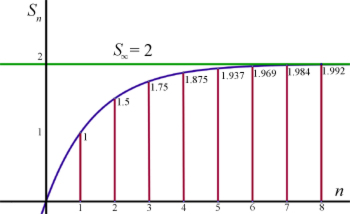
Let's say I take a series of numbers, and add them up, and that series continues all the way out to infinity. For example, the series 0, 1, 2, 3, 4, 5... is added up in an infinite series 0+1=1, then 1+2=3, then 3+3=6, then 6+4=10, then 10+5=15, etc. all the way out to infinity. The answer of this series, summed up, is infinity. And in mathematics, this is called a divergent series.


Are there number series that don't add up to infinity? Are there series that converge to a limit, that are convergent? Consider the halving fractions, the geometric progression: 1, 1/2, 1/4, 1/8, 1/16, 1/32,... and when you add up the series, you get, 1+1/2= 3/2, then 3/2+1/4=7/4, then 7/4+1/8=15/8, then 15/8+1/16=31/16, then 31/16+1/32=63/32... So it looks like the series can be added up to 1/infinity and never quite get to 2! And that's what happens.


It turns out there are all sorts of infinite series like this, that will converge to some number, even though they have an infinite number of terms to add up. And I borrow this concept for those possible worlds, within all possible worlds, where we, as a species, survive. Since we, as a species, survive, this the best of all possible worlds. 

(What is so important about we, as a species, surviving? Well, I'm in the stories. It's about me, right? So it's probably best that humanity get to tag along as well). 

As it turns out, in my pretend world, all those possible worlds where we survive, big picture and long term, eventually converge to that one world, thus termed The Convergence.


(And yes, I know the unfortunate tendency in science fiction to whup out the capitalization for important shit, and I will try to keep it to a minimum).


So, all of those worlds where we don't make it? Those are called Divergences.


What else? How is this all known? I took a shot at it in the essay "2050CE: A Fable". And in that particular parallel universe, wherein Mark Everett, son of Hugh Everett III, is not a mathematically challenged rock and roll star, and wherein Hugh Everett III, PhD, has produced a coherent set of equations that allow for the empirical and theoretical exploration of parallel worlds. These are discovered in the basement of the family home, and are called, appropriately enough, The Basement Equations.

And they allow for, among other technological marvels, such as wormholes (once, of course, the materials science and ancillary technologies are up to speed), the construction of the Peranoscope.

Google tells me this word does not exist. Google suggests "panoscope" or "pianoscope". Hmm. I kind of like pianoscope, but no.

Kurman has created a neologism! I construct this word, from the Greek peran-, an apparently accusative case of an obsolete derivative of the word piero  "to pierce", meaning "beyond, over, across, on the other side, farther side", and scope (like microscope, or telescope). And the peranoscope (though important, I don't think it needs constant capitalization) is a device that allows one to see all possible outcomes to an action. 

A Peranoscope
It shows you what happens if you had chosen heads instead tails, gone left instead of right, or even that you could not have gone left, but only right. And with the peranoscope, one can find one's way into that world known as the Convergence.


Is this enough masturbation for one essay? I think so. The hard part is, you know, actually writing a story to inhabit this worldbuilding exercise.


Oh, wait, what about those aliens? The Kraken? Comic relief, maybe? I've a feeling this story will need a light touch, ala Stanislaw Lem (big, big fucking fan, RIP).


Oh, and what about those abandoned Texans? The ones thrown millions of light years from Earth, and thousands of years into the past, feeling maybe a little resentful and orphaned? Well, I don't want to get the story line too complicated, but they are there just in case I need to write a space opera, with cattle. 

I mean, who better to chew up the scenery in florid melodrama then our friends from down Texas way, now, uh, out Fornax way?

Tuesday, March 6, 2012

The Failure of Fantasy Revisited

Castle Of Sin by Frank Frazetta
Some time ago, I wrote an essay surrounding the literary tradition of fantasy. Upon rereading that essay, I wish now to recant many of what now seem parochial and limited opinions of that genre.

(I will, however, reproduce the one worthwhile attribute of that essay, a painting by the late and great Frank Frazetta, depicting some spectacularly well-muscled feminine pulchritude).

My greatest crime against fantasy was the contention that science fiction was socially relevant, that fantasy, as only an escapist vehicle depicting simpler times, or, as I said a "jerk-off fantasy about medieval romanticism.

I regret that remark. There are forms of fantasy, I believe now called "urban" or "modern" that are devoted to exploring social themes, and in some ways not permissible to science fiction (or at least the "hard" variety).

What changed my mind? I think the course correction was two-fold. The first, though only a trigger, was picking up the Vernor Vinge's new book "Children of the Sky" from the library. The book itself, so far engaging, was not the real impetus, but a trigger, in that it made me go back and reread Vinge's 1993 essay on the Singularity. This essay was intended as informed speculation, though I think Vinge still believes that a technological leap towards a transcendent superhumanity still lies in our future. As to whether that future is all happily-ever-aftering, or something more less than perfect, the point is that future becomes opaque. All conjecture becomes pointless. All bets are off.

But within the context of literature, of world-building, Vinge, I think, rather than setting up a barricade, threw down a gauntlet.

"All of your ideas about the future, the posthuman or superhuman future, are based upon historical trends", Vinge seems to say,"and thus, your futures of galactic exploration utilizing the metaphor of the age of sail, or of a machine intelligence using cogs and steam are as ludicrous as they sound. Imagine better! Make it fucking awesome! Make it... psychedelic!"

In other words, stories set for the far, far future, which typically allowed for more phantasmic elements, were now allowed for advanced technologies.

Which brings the second vector component of my course correction, Arthur C. Clarke's Third Law:
"Any sufficiently advanced technology is indistinguishable from magic."
I interpret Clarke's statement in two ways, or rather, suspect he interpreted it in two ways. The first being that in terms of future predictions, one can afford to be a little crazy, provided that there is some method of grounding the miraculous technology with in the known laws of physics. (And my take there is, for example, it's probably a good thing, good in scare quotes, that humanity can build H-bombs, in that it means we have a pretty good handle on the known laws of physics. I have covered some of the physical limitations that technology must recognize, but these limits in no way preclude some pretty amazingly magical shit in our speculative future). 

The second being that, in that clever and classic British no-nonsense pragmatism, Clarke suggests there's a logical explanation behind all the hocus-pocus, and we are not savages or scared little children to be frightened of ghosties and goblins and things that bump in the night. In other words, regardless of the usual sense of awe and wonder that the so-called supernatural evokes in us, it is no less (or does not compare to) the awe and wonder of the natural world. In other words, the actual explanation, prosaic to some, actually turns out to be even more bizarre and spectacular than the mystical mumbo-jumbo bullshit.

What's my point here? I guess it's that, Vinge's literary notions of the Singularity, rather than limit the number and kind of stories to tell, actually liberates us into a whole new realm of fantasy.

Thursday, March 1, 2012

The Empire of Dixie

I came home to a message on my answering machine from my doctor. I had a yearly physical last week, and I had blood tests done (even though my shit insurance will not pay for it - sound familiar?), and the doctor left the following message:

"John , this is Doctor ______. We found some abnormalities in your blood tests. I'd like you to call me today or tomorrow afternoon to discuss this".

He pulls this shit with me every year. Of course there are abnormalities. I eat badly, don't drink enough water, and besides that, I'm Scandinavian. And let tell you, 2100 generations of serious inbreeding can really fuck up your blood chemistry. So, I've got to assume it's usual medical bitching, but in case it actually is serious, then I need something to distract me, so....

Astronomers can "see" out to the cosmic horizon some 42 billion light years.  Using this number as the radius for a spherical volume, and applying the formula for such (4/3 * π * r3), and doing a small amount of arithmetic reveals that the observable universe contains some 310 x 1028 cubic light years, or if you like really big numbers, 630 x 1066 cubic miles.

And that's mostly empty space. If we are very generous, and assume, say, an average of a million earthlike worlds per galaxy, give all the observable universe some one hundred trillion galaxies, then there are some 1018 habitable worlds in the universe, which, if they were all uniformly distributed, gives you a habitation density of some 1 / 1048, and that is one in a quindecillion. And that is a very, very tiny number indeed.

I don't think there is any comparable ratio to this tiny number, but it really doesn't matter, because it turns out that - and I know this for a fact - that there are only nineteen earthlike worlds in the whole observable universe.

Just nineteen.

That's only nineteen worlds that humanity could be living on and not notice too much of a difference from living on the Earth. You know, blue skies, green grass, trees, sandy beaches, stuff like that. The animals only slightly different, but not enough to be alarming.

You'd think it would be a lot higher number, but no. And apparently it has something to do with ours being a double planet. And through an accident of history, one of those worlds is called Texas. And that world is the center of a space opera empire spanning a whole galaxy group, and that empire is known as The Empire of Dixie.

How'd that happen? Well, one of the first wormhole throats ever constructed was down in Houston, TX --- naturally. It was built inside the Harris County Domed Stadium, oh, sorry, the Reliant Astrodome, no, fuck it, the Houston Astrodome, after it was annexed by the Johnson Space Center --- naturally.

I guess a description is in order. At the former fifty yard line is an airtight sphere contained in a chiral two-layer geodesic metal skeleton some 150 feet in diameter. Up in the stands surrounding the inner dome, where countless baseball, football, and professional wrestling fans used to sit, is the world's thirty-fifth largest standing army, bristling with everything from futuristic railguns down to M-4 combat assault rifles, all pointed at that sphere. And inside the geodesic sphere is a smaller concentric spherical structure, consisting of tiered stainless steel catwalks, struts, trusses, ranks and ranks of boxes filled with exotic matter and  transmaterial generators (used to generate, you know, wormholes), even more ranks of banks of electromagnets,  particle accelerator tracks wound throughout like a giant ball of yarn, cables, stanchions, hoses, pumps, sensors of every kind and description, wires, yellow hazard signs, and throughout, like a swarm of fire ants, essential ground personnel suited up in space suits - every single one of them deemed expendable.

And then, within of all of that, on a day when the wormhole throat is open, everything is bathed in a Cherenkov glow, blue to violet radiation emanating from a shimmering soap bubble, some thirty to seventy feet across, that hovers above the ground. Soap bubble? More like a big crystal ball, with strange shifting visual aberrations at the edges, which give me a headache when I look at them, and if you can handle staring into the center, some other fucking place entirely. Weird!

Well, funny thing about wormholes - aside from the fact that they are hard to aim and the destination throat won't sit still - is that they open up through space and time. You know, spacetime?

So, sometimes that target throat is a billion light years away and a day ahead, and then a billion light years plus or minus a mile and a millennium, or a microsecond and fourteen billion light years off. And then you open it up again to the same coordinates, and - nothing. Not even close to the last time and place.

And the people that went there? Lost forever in space and time, for all we can tell. Oh, they are out there someplace, somewhere, somewhen. You just can't seem to get back to them, not with the perverse vagaries of an uncertain universe surrounding us.

So, when the first wormhole was created, and what do you know? that wormhole throat opened up within the solar neighborhood of one of those nineteen worlds. And a fantastically gorgeous blue world it was, with a striking golden moon.

Within a month practically the whole of state of Texas, Arkansas, Louisiana, then Mississippi, Alabama.... practically the whole of Dixieland had jumped on through and good riddance to old Earth. Keeping the aperture open taxed the ERCOT power grid to the point they finally had to close it down.

Some two months later, the grid beefed up,  hordes of potential colonists camping out throughout the greater Houston area, the wormhole was opened up again and - nothing. No world. No star. A completely different region of the universe presented itself, despite the best efforts of the theoretical physicists to target the original coordinates. Some fifty million people simply gone, lost out there in the universe someplace - a complete mystery.

The Kraken - naturally - solved the mystery. Soon after first contact, they mentioned an interstellar civilization of "you monkeys" occupied a galaxy some 60 million light years distant, out in the Fornax cluster. Turns out that was the world we had sent them to - only they arrived there some 13,000 years in the past, according to our calendar. The Kraken advised us to maybe steer clear of that region of space for awhile, at least until Earth had worked its way a bit higher up the slope of the technological plateau.

But the Kraken did show us a video of that lost homeworld. Still blue and gorgeous, and with the night side ablaze with city lights. And a large sublight dreadnought can be seen warping up from the planet to interdict the Kraken ship.

And the golden moon? In waning gibbous phase from the point of view of the video. But on the darkened side of that moon, looking for all the world like a neon sign in a diner window:

"Welcome to Texas".