Thursday, March 1, 2012

The Empire of Dixie

I came home to a message on my answering machine from my doctor. I had a yearly physical last week, and I had blood tests done (even though my shit insurance will not pay for it - sound familiar?), and the doctor left the following message:

"John , this is Doctor ______. We found some abnormalities in your blood tests. I'd like you to call me today or tomorrow afternoon to discuss this".

He pulls this shit with me every year. Of course there are abnormalities. I eat badly, don't drink enough water, and besides that, I'm Scandinavian. And let tell you, 2100 generations of serious inbreeding can really fuck up your blood chemistry. So, I've got to assume it's usual medical bitching, but in case it actually is serious, then I need something to distract me, so....

Astronomers can "see" out to the cosmic horizon some 42 billion light years.  Using this number as the radius for a spherical volume, and applying the formula for such (4/3 * π * r3), and doing a small amount of arithmetic reveals that the observable universe contains some 310 x 1028 cubic light years, or if you like really big numbers, 630 x 1066 cubic miles.

And that's mostly empty space. If we are very generous, and assume, say, an average of a million earthlike worlds per galaxy, give all the observable universe some one hundred trillion galaxies, then there are some 1018 habitable worlds in the universe, which, if they were all uniformly distributed, gives you a habitation density of some 1 / 1048, and that is one in a quindecillion. And that is a very, very tiny number indeed.

I don't think there is any comparable ratio to this tiny number, but it really doesn't matter, because it turns out that - and I know this for a fact - that there are only nineteen earthlike worlds in the whole observable universe.

Just nineteen.

That's only nineteen worlds that humanity could be living on and not notice too much of a difference from living on the Earth. You know, blue skies, green grass, trees, sandy beaches, stuff like that. The animals only slightly different, but not enough to be alarming.

You'd think it would be a lot higher number, but no. And apparently it has something to do with ours being a double planet. And through an accident of history, one of those worlds is called Texas. And that world is the center of a space opera empire spanning a whole galaxy group, and that empire is known as The Empire of Dixie.

How'd that happen? Well, one of the first wormhole throats ever constructed was down in Houston, TX --- naturally. It was built inside the Harris County Domed Stadium, oh, sorry, the Reliant Astrodome, no, fuck it, the Houston Astrodome, after it was annexed by the Johnson Space Center --- naturally.

I guess a description is in order. At the former fifty yard line is an airtight sphere contained in a chiral two-layer geodesic metal skeleton some 150 feet in diameter. Up in the stands surrounding the inner dome, where countless baseball, football, and professional wrestling fans used to sit, is the world's thirty-fifth largest standing army, bristling with everything from futuristic railguns down to M-4 combat assault rifles, all pointed at that sphere. And inside the geodesic sphere is a smaller concentric spherical structure, consisting of tiered stainless steel catwalks, struts, trusses, ranks and ranks of boxes filled with exotic matter and  transmaterial generators (used to generate, you know, wormholes), even more ranks of banks of electromagnets,  particle accelerator tracks wound throughout like a giant ball of yarn, cables, stanchions, hoses, pumps, sensors of every kind and description, wires, yellow hazard signs, and throughout, like a swarm of fire ants, essential ground personnel suited up in space suits - every single one of them deemed expendable.

And then, within of all of that, on a day when the wormhole throat is open, everything is bathed in a Cherenkov glow, blue to violet radiation emanating from a shimmering soap bubble, some thirty to seventy feet across, that hovers above the ground. Soap bubble? More like a big crystal ball, with strange shifting visual aberrations at the edges, which give me a headache when I look at them, and if you can handle staring into the center, some other fucking place entirely. Weird!

Well, funny thing about wormholes - aside from the fact that they are hard to aim and the destination throat won't sit still - is that they open up through space and time. You know, spacetime?

So, sometimes that target throat is a billion light years away and a day ahead, and then a billion light years plus or minus a mile and a millennium, or a microsecond and fourteen billion light years off. And then you open it up again to the same coordinates, and - nothing. Not even close to the last time and place.

And the people that went there? Lost forever in space and time, for all we can tell. Oh, they are out there someplace, somewhere, somewhen. You just can't seem to get back to them, not with the perverse vagaries of an uncertain universe surrounding us.

So, when the first wormhole was created, and what do you know? that wormhole throat opened up within the solar neighborhood of one of those nineteen worlds. And a fantastically gorgeous blue world it was, with a striking golden moon.

Within a month practically the whole of state of Texas, Arkansas, Louisiana, then Mississippi, Alabama.... practically the whole of Dixieland had jumped on through and good riddance to old Earth. Keeping the aperture open taxed the ERCOT power grid to the point they finally had to close it down.

Some two months later, the grid beefed up,  hordes of potential colonists camping out throughout the greater Houston area, the wormhole was opened up again and - nothing. No world. No star. A completely different region of the universe presented itself, despite the best efforts of the theoretical physicists to target the original coordinates. Some fifty million people simply gone, lost out there in the universe someplace - a complete mystery.

The Kraken - naturally - solved the mystery. Soon after first contact, they mentioned an interstellar civilization of "you monkeys" occupied a galaxy some 60 million light years distant, out in the Fornax cluster. Turns out that was the world we had sent them to - only they arrived there some 13,000 years in the past, according to our calendar. The Kraken advised us to maybe steer clear of that region of space for awhile, at least until Earth had worked its way a bit higher up the slope of the technological plateau.

But the Kraken did show us a video of that lost homeworld. Still blue and gorgeous, and with the night side ablaze with city lights. And a large sublight dreadnought can be seen warping up from the planet to interdict the Kraken ship.

And the golden moon? In waning gibbous phase from the point of view of the video. But on the darkened side of that moon, looking for all the world like a neon sign in a diner window:

"Welcome to Texas".

Wednesday, February 29, 2012

What is Money?

Some of the more academic chatterbox parts of the intertubes have been abuzz over Peter Graeber's 2011 book "Debt: The First 5,000 Years". I'm still waiting for this book to be returned to the library, so I can read it, but since everyone is talking about it now, the spoilers are out.

And the main gist I will take from John Quiggin's rumination about money. I enjoy Quiggin. Don't always understand him, but I enjoy him. My comment might flummox him some, as one of his goals is to make things understandable.

In any case, here's what I gather from what he gathers about the book:
"Graeber shows, convincingly enough for me, that the story conventionally told by economists, in which money emerges as a replacement for barter systems, is nonsense. In fact, as he notes this point has been made by anthropologists many times and ignored just as often. Thanks to the marvels of auto-googling, I’ve been aware for some time that my namesake, Alison Hingston Quiggin gave the definitive demonstration long ago in her ‘Survey of Primitive Money’. Graeber sharpens the point by arguing that the real source of money is as a way of specifying debts".
So, the usual definition of money as a medium of exchange, an abstracted symbol representing an exchange of material goods or commodities, is wrong. Instead, since money was, according to Graeber, created to keep track of irredeemable debt between entities both solitary and aggregated, per Quiggin:
"From now on, we can treat money primarily as a store of value, and stop worrying about how it works as a medium of exchange".
I'll get back to why I emboldened and italicized that phrase in a moment. In another region of the intertubes, one in which many, many people were asked and answered the question "What is money?", I answered with the following:
"Money is what I shall gladly do for you on Tuesday, for a hamburger today."
Meaning, of course, that I already recognize the debt portion that Graeber wants to talk about, and also the irredeemable portion as well. That's the whole frickin' point of debt, it is a promissory transaction.

For, anyone who knows the tale of Wimpy, Tuesday will never come. Let's be clear though. This is not to Wimpy gets a free lunch. He sometimes does. Sometimes he doesn't. But when he does gladly pay on Tuesday, the payment he makes for the value of the hamburger will always be less than the hamburger. What is meant is that, in all transactions, there is always an inequity. Forget all changes wrought through the internal contradictions of capitalism, the psychological warfare of mercantilism, the other weird tribal customs and superstitions surrounding social orders, the fact is, through physical scarcity or plenty, through chance and contingency, through entropy at the very least, the winding down of the universal clock itself, the value of an object, from moment to moment, will never, ever be the same.

(To throw in a dig at the ridiculous libertarians: The whole egalitarian and idealistic notion that libertarians espouse "No force or fraud" is physically impossible. Barter is, by its very nature, inequity. Profit is just another name for "force and fraud").

Getting back to that emboldened italicized phrase. Value is not classical physics. It contains no clock parts. It is not a Newtonian transaction. It cannot be connected by strings and wooden rods. The value of something is neither continuous nor continuously changing.

Consider: right at this very moment, I hold a lump of gold in my hand. I do.

It is a knuckle bone sized lump that I took out of the jewelry instructor's cabinet. (I do this from time to time, because I like the feel and heft of it, and then I put it back). This lump of inert material, probably microscopically changing as little atoms rub off onto my skin, and perhaps the occasional radioactive decay turns a rare atom of gold into iridium, but still and all it sits pretty much the same lump from human-sized moment to moment. And yet the value of the gold lump is jittering and chittering up and down and sideways like a crazy wavicle with each quote on the spot market, and nowadays, with computers, at lightning speed.

Value is spooky action at a distance. Value is quantum entanglement. Value is an absolute value of an amplitude representing a probability. And money? Nothing more than the decohrence of an entangled state.

If entanglement is grace, then money is it's fall. 


Tuesday, February 28, 2012

Completely slipped my mind -

- I broke up a fight at the college this past Friday. Actually I prevented a fight. Probably.

I was done for the day, dropping off my timesheet at the admin building. There is a designated smoking area in a covered walkway outside of the entrance. I heard shouting as I approached, and coming around the corner, two heavyset kids engaged in a shoving and shouting match. A smoker crowd stood in the background away from them, and a small slight kid, with his eyes to the ground, was attempting to intervene, saying "Calm. Calm".

They were both dressed, actually they were all dressed, in what I am told is a now a years out-of-date gothic/punker garb, with metal studs and chains hanging on their pants and shirts. Kind of like what is pictured here, but not quite.

Both kids were getting louder, and the shoves more forceful, and so, as an employee of the college, and, wow, an official adult I guess, I had to intervene. I remember feeling very tired and put upon to have to do this bullshit, and sighing to myself "oh for christsake". But in any case, I mustered up my best drill sergeant voice, and said, with just the right volume, loud enough to startle, "HEY!".

That broke the spell on them. So I glared really intensely at them, the way I'm really good at, the way that I'm told scares most people, and followed it up with a "...don't you boys have a class to go to?"

They both instantly kind of slumped, and started whining at me about how it was his (the other guys) fault, so I ended the whole scene with a very tired, almost Nick Nolte kind of growled "Get the fuck outta here!"

And they did.

And then I went into the building just in time to watch Security hustling towards me. A kid and an older guy in uniforms, and the old guy has a holster on him. I think the only campus cop allowed to carry. The altercation must have went on long enough that someone called it in.

I said "Are you guys looking for the fight?"

"Yeah!"

"It's over with. I broke it up".

"Oh" and then, once that sunk in, "Oh sir. No. No. You let us handle that next time".

I waved my hand in invitation, "Me casa es su casa" I replied, getting a puzzled look in turn.

I invoke Rodney King quote, "Can't we all just get along?"

And the answer is, "When you compare us to the other Great Apes, Rodney? We are pretty fucking calm".

If chimps could use guns, they'd have wiped themselves out a million years ago.

So, despite appearances to the contrary, we actually do get along pretty damn well.

Monday, February 27, 2012

"We Meant Well": A Book Report

"We Meant Well: How I Helped Lose the Battle for the Hearts and Minds of the Iraqi People" by Peter Van Buren. This book is part of a book series available through the American Empire Project.

"Better an Archduchess should be fucked than the monarchy". This summation of Habsburg diplomacy was uttered after Napoleon Bonaparte was married to Marie Louise, daughter of Francis I, Emperor of Austria. Substitute "Iraq" for "Archduchess" and "the American Empire" for "the monarchy", and you have an equal summation of the subject matter of this book, which I recommend to you.

When I first acquired this book from the library (and actually, not my first choice, but "Debt: The First 5,000 Years" by David Graeber is not due back until the 21st of March), the book had two dog-eared pages in it. When I finished reading, it had succumbed to eighteen more folded corners. I cannot possibly include all the quotations I would wish to include, so again, the best thing to do is read the book.

At a personal level, when a person endures suffering and privation, it is a hard enough portrait to experience. Multiplied by the millions, taken to the national level, it overloads our capacity to think and to feel. And so, we shut down our humanity, academize the pain, squalor and indignities into tidy geopolitical issues. This book attempts to strip away these tawdry and dishonest decorations, and attempt to provide a narrative of just how bad it can be. The treatment the people of Iraq underwent, at the hands of the US State Department is and was, for the most part, criminally incompetent. The author uses the term "disresponsible", a step beyond irresponsible, as in "should have taken the responsibility, but shucked it off. Oh, not all the blame can be laid at the feet of the risibly clueless professional caste of the elite American diplomatic 1% corps. Plenty of blame is there to be spread, in turn, down the line, through the parasitic contractor companies, to the level of the corrupt local sheiks and thugs.

This is not to say that reading this book is one long bummer, although there are some chapters that are so goddamn depressing as to make it an act of will to read to the end. The book is darkly funny, as in any building exercise, where the attempt is made to mold the vanquished in the image of the victor, the road to hell, paved with taxpayer dollars, cannot help but occasionally be deeply darkly funny. And van Buren is up to the task of finding those few elements of cynical humor, with choice bits well-represented by all four corners of Hippocratic humours: blood, phlegm, black, and yellow bile in just the right proportions.  Starting, of course, with the book title. No wry observation, when it comes to competency, could be more devastating than the term "We Meant Well". Anyone who has ever worked in an organization larger than Dunbar's Number, be it a multi-national corporation, large religious orders, or the Austro-Hungrarian Empire, will feel right at home in this book.
"In addition to the $63 billion Congress had handed us for Iraq's reconstruction, we also had some $91 billion of captured Iraqi funds (that were mostly misplaced by Coalition Provisional Authority), plus another $18 billion donated by countries like Japan and South Korea. In 2009, we had another $387 million for aid to internal refugees that piad for many reconstruction-like projects. If that was not enough, over a billion additional US dollars were spent on operating costs for the Provisional Reconstruction Teams. By comparison, the reconstruction of Germany and Japan cost, in 2010 dollars, only $32 billion and $17 billion respectively".
Despite two decades of forced privation and occasional bombings on the parts of the Bush 1 and Clinton administrations, despite the corrupt and criminal rule of Saddam and his spawn, prior to the Bush 2 invasion, unemployment numbers were estimated at around 30%, average number of slum dwellers under Saddam totaled around 20%. In 2010, unemployment numbers were at least 50%, the United Nations in 2009 estimated 57% of all Iraqis lived in slums.

I conclude, not my usual style, with a jacket blurb from someone I respect.
"Long after the self-serving memoirs of people named Bush, Rice, and Rumsfeld are consigned to some landfill, this unsparing and very funny chronicle will remain on the short list of books essential to understanding America's Iraq War. Here is nation buidling as it looks from the inside - waste, folly, and sheer silliness included" - Andrew J. Bacevich 

Thursday, February 23, 2012

"If only he'd used his powers for good-"

Baby brother is a True Crime fanatic.  I'm not sure how it entered our household, but the initiator, the spark that started the flame, had to have been the book "Bloodletters and Badmen" by Jay Robert Nash, an American encyclopedia of crime "from the Pilgrims to the present".  Baby brother had this book memorized before the age of probably ten. His appetite for the gruesome and bizarre has yet to be sated. I confess I also have a morbid curiosity towards the diabolically clever misdeeds, but my interest cannot hold a candle to his abiding obsession.

(I should note that baby bro also presented me with the Three Name Conjecture - that all successful assassins are referred to by their full name: John Wilkes Booth, James Earl Ray, Lee Harvey Oswald, Mark David Chapman, &c, &c. I pointed out that John Hinckley, would-be assassin of Ronald Reagan, is referred to as John Hinckley Jr., and his response was "How do you know Reagan wasn't assassinated and a lookalike replaced him"? Hmmm).

In any case, we somehow started talking about Dr. John Schneeberger. He managed to avoid arrest by spoofing a DNA test of his blood by implanting surgical tubing filled with another man's blood in his arm and fooling the forensic lab technician into sampling blood from the tube instead of his own veins.

Damn, that is a diabolical genius. To which baby bro offered up the TV trope "If only he had used his powers for good, instead of evil". To which I offered that I didn't think so. That this type of cleverness could only be used for evil purposes, and if tried to be cleverly benevolent, he would utterly fail. Or more to the ironic point of the Simpsons, he would be like Mr. Montgomery Burns, who is even more evil when tries to do good.

Which brings me to news which recently caught my attention, that the equity market is completely fucked up. And if I am looking for blame, I've got to point a finger at high frequency trading (HFT). Done in time span of milliseconds, these trades, carried out by sophisticated algorithms on supercomputers, are really nothing more than a form of parasitism upon financial networks. To those not familiar with the unsavory practice, it looks a lot like an artificial insertion of a middle man, a greasy Mob transaction, wherein "shipping and handling" is done for a markup fee without any true added value occurring.It is basically a form of extortion.

It goes like this. Most HFT transactions are made to "sniff out" the demand for a specific stock. So, ehre I am an institutional buyer, noting (in human time) that a particular stock looks a 'buy' or a 'buy and hold'. People start to buy, and the price of the stock goes up. The evil opportunistic algorithms operating on supercomputers, note this, issue buy orders for the stock and then, a millisecond later, cancel the transaction. They can do this, since 'their' microseconds are 'our' seconds, thousands of transactions per second. By ordering and cancelling a stock, they can determine what maximum market price much the buyer is willing to pay, and then they buy and sell the stock to the unwitting human. The brokerage using the HFT strategy thus pockets both the brokerage fee, and the articifical profit generate through the computer churn on the market.

It's an old scam. It goes back a long time, wherein a 'club' of buyers artificially bids up the price of something by incestuously selling it at increasing values between members of the club, until finally dumping the inflated stock onto the suckers, e.g the market. Almost immediately the price drops to nothing, leaving the consumer to absorb the costs of the entire transactional clusterfuck.

Interestingly, fully 60 to 70% of all transactions done on the US market are HFT transactions. Of those transactions, more than 95% are immediately cancelled. In total, only 2% of the 20,000 brokerages account for all HFTs, according to this article. Those are the vampire squid motherfuckers sucking on the face of humanity.

The consensus suspicion of market manipulation is that HFTs were responsible for the May 6th, 2010 Flash Crash, when the market dropped some 600 points, and then rebounded  some minutes later. Market volatility is now at an all time high, as seen in this article from Zero Hedge.

The worry now is that HFTs pose continual future risks of more crashes and spikes to come. So much so, that it garnered the attention of the physics community, as seen in this article: "Study links ultrafast machine trading with risk of crash".

The authors examined the price logs of over 60 markets from 2006 through 2011. They discovered what they termed "fracture events" within the market during this period, some 18, 520 ultrafast black swan events". Given the speed at which they occur, it is impossible for human supervision to control these events, and black swans have a nasty tendency to turn into Dragon Kings.

Since the Flash Crash, the SEC has implemented circuit breakers, but many fear this is not enough. One suggestion is for the implementation of filters in traffic that would slow down opening transactions but not closing transactions, which would hinder a price collapse. Another suggestion is to keep orders exposed for a full second, to accommodate the glacially slow human reaction time. This would reduce the volume of HFT transactions, but not halt them. Still another suggestion is introduce (or rather, reintroduce) a small "Tobin tax" upon all share transactions, thus making most HFT scams unprofitable. The latter suggestion seems eminently doable, and makes the most sense.

Nevertheless, I took it upon myself to read the paper behind this article ("Financial black swans driven by ultrafast machine ecology", http://arxiv.org/abs/1202.1448, if interested), and was struck with the fact that there are algorithmic ways of preventing fractures:
"Just prior to a large change, the resulting system is therefore (momentarily) largely deterministic. If left alone, it will produce a large change in a definite direction - however, it can be driven away from the impending crash or spike by increasing the strategy diversity in the following ways, listed here in order of increasing effect but also increasing assumed knowledge: (1) if little is known about the system, our earlier expressions for η < 1 predict that increasing the disorder in the initial strategy allocations by adding agents with randomly chosen strategies will reduce the scale of fluctuations toward their lower bound..."
 Okay, okay, there are two other methods listed, but the operative phrase here is insert new agents. In other words, have an computerized algorithmic army out in the transaction space, spiders, searching for unusual transactions, who, when they detect this type of scam, fuck with the HFT brokerage firm's computers.

How to do this? Well, conficker comes to mind. Ten million or so CPUs, strategically scattered throughout the globe, all of them fairly near optimal intermediate trading node locations, all running continuously in the background on their pirated PCs, ready to fuck up Wall Street's scams.

Antibodies, if you will, to be used against some particularly nasty viruses.

If not conficker, then, perhaps a botnet for the rest of us.

Now wouldn't that be cool?

Friday, February 17, 2012

Why isn't String Theory considered Outsider Science?

Why aren't string theorists considered cranks. They themselves insist that if there is no empirical proof, then string theory must be considered philosophy. I think they are being overly generous in their dismissal. It should be considered outright bullshit. Wishful thinking. Voodoo.

Okay, okay, I know it's all now called M-theory. And any number of books and blogs are out there that say it is all just bullshit. You've got Peter Woit's ongoing blog: "Not Even Wrong", and his book: "Not Even Wrong: The Failure of String Theory and the Search for Unity in Physical Law". You've got Lee Smolin and the Perimeter Institute investigating loop quantum gravity. Smolin has written a critical book as well: "The Trouble With Physics: The Rise of String Theory, the Fall of a Science, and What Comes Next".

There is still, to this day, absolutely no empirical proof that string theory is correct, or even that it can predict anything worthwhile. The theories have produced what is known as "The Landscape", which consists of perhaps 10 to the 100th power various predicted universes 9although probably more like 10 to the 10500th power). One wag, I think one of the actual theorists, perhaps Susskind, has apocryphally been quoted that "it predicts every possible universe --- except ours". 

String theory apologists, such as Brian Green, have attempted to rationalize its failures by invoking the childish excuse that "no other theory does any better", or worse, invoke the multiverse in a bit of hand-waving to suggest that it somehow all works out.


But still there is that troubling lack of empirical evidence.


Science, at this stage of the game, consists of a foundational triad. The earliest, and still best foundation, is empiricism. If your beautiful theory contradicted by ugly facts, it's bullshit. This goes all the way back to Francis Bacon, and of anything, it separates the practitioners from the cranks. 


The second foundation is theoretical physics, which is where string theory resides. There have been many cases where theories derived "from pure thought" (as Albert Einstein once put it, and I had trouble understanding that remark until I realized he actually meant an argument built up  as the medieval scholastics did, as in "derived logically from prior inputs"). This has, in almost cases, after the fact, been every successful at explaining mysteries. But one must always, always, resort to empiricism as a verifier.

The third, most recent, and extremely promising, foundation is the Monte Carlo simulation, first automated back in the 1940s at Los Alamos, and today, built up into impressive computational models. Again, there have been successes where the mathematical theory becomes far too complicated for a general solution. But simulation seems to help. We run into (as it turns the same or similar problem theory runs into, which is, even with a watertight logical consistency, your model is only as good as the assumptions. Or in the hep parlance of today "GIGO: Garbage In, Garbage Out".

So again, I ask, why are string theorists not considered cranks? I'm not the only one asking this question. Margaret Wertheim, in turn, has a book out called "Physics on the Fringe", which delves into the world of Outsider Science. I've not read it, but I don't think she interviewed Brian Green. She should have.


I would note the defensive comment in the American Scholar article, by one Pavel Nadolsky, who notes that:
"Many difficult calculations that particle theorists have been doing are greatly simplified by organizing them along the lines suggested by string theory. These calculations are tested experimentally at the Large Hadron Collider and Tevatron, and the experimental data agree with what the string-inspired theoretical methods predict! In this sense, some implications of string theory are experimentally testable".
True enough Pavel, in the same sense that the explanation of the origin of the universe is not directly testable, one can only build up a evidentiary case for it, one that is mutually consistent. And, as such, the evidence for a Big Bang gets an A minus. One cannot say the same thing for string theory, which, particle colliders or no, still comes in at around a solid D, perhaps even a high F (if there is such as thing). You need a lot more evidence, Pavel!

Or, as Richard W Hamming once said "Many a theoretical physicist has gotten the right number with the wrong equation".


Wednesday, February 15, 2012

About those Kraken...

I've been preoccupied with maintenance tasks the past few days. They are mostly, in one form or another, time-consuming and mentally effortless enough to allow me time to daydream. And  I've been thinking about a little worldbuilding behind the alien Kraken I introduced a little while back. I was going to draw a picture of one, but I've found out that, not having drawn anything in ten years, my illustrating skills have eroded back to about the 6th grade.

True, some of the machine fixing and cleaning tasks required just enough mental effort to annoy me. Others led me to ponder over the ongoing mystery of how little old ladies somehow have enough strength to break shit that a gorilla can't break. Is it just cussed persistence? Carefully concealed superstrength? I don't know.

I always assume I have more time between maintenance cycles with the old farts, assuming it takes them longer to break shit. You'd figure it's the youngsters to watch out for... but no.

So, and also the metal shop had been past due in the schedule, and that proved to be most amusing. The things you find when cleaning out the machines, for example, provide me amusement. Just the fact that you can find a solid two-inch thick block of sintered powdered metals and abrasives in some of the chop saws and band saw cowlings gives a rueful indication as to how often these machines are looked after.

I found an award plaque for Buffalo Grove High School, 1976 wedged in the bottom of the disc grinder's vacuum dust chute. Well, now I know one instance of how often...

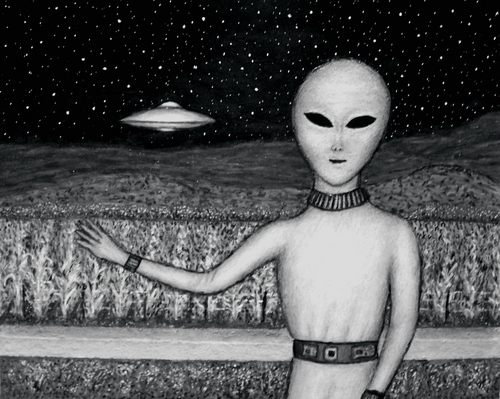
"Grey Alien" by Stephen Warde Anderson
Needs a whole lotta love
In any case, it gave me time to build up a world around these alien creatures. It's fairly difficult to come up with a convincing alien creature, given that we have kind of a limited knowledge as to what they look like. Oh, you've got the Greys. But, that's so lame. It's just a human fetus. Not very imaginative.

The story behind my kraken, which is just a big giant furry octopus, goes back to my college days. A friend of mine and I were having a stoned conversation about Intelligent Life in the Universe. His three-year-old daughter threw a stuffed toy onto the couch. It was a little plush octopus, with googly eyes and a toothy shark's grin.

I said, "Here, this is what real aliens look like. But a lot bigger. They are furry octopoids, and they are Earth's closest alien neighbors, residing 500 million light years from here".

That got a laugh, but it also stuck with me. I mean, why would aliens look terrestrial, let alone look anything like us? And why reside in our galaxy, when we had a whole universe to stage a drama in? Why, even the octopus form is familiar, symmetric, with recognizable sensory organs and familiar appendages. Not really alien. Not really not of this world.

So, I had time to build up a history around this creature, and here's what emerged. Did I say history? Fantasy.

They are originally from a world that orbited a yellow-white F-type dwarf star. (I use the past tense because it's all gone now, the star expanded into the red giant stage, and the world a crispy critter). It was actually a double world, a binary planet, with the "moon" about three quarters the mass of their home world. Which makes their "moon" bigger than he Earth. And their world, their home world, was about 1.78 times the mass of Earth, with a similar density but slightly lower metallicity. Gravity there was about 1.5 times Earth gravity. Thus the eight legs to hold them up. 

The Kraken race is perhaps a billion years older than us in terms of sapience, and life on their planet appears to have evolved faster. This may have been due to the more frequent extinction events. There are parallels to Earth's geological history. They had a space debris bombardment. They had several global glaciation events. And at least two runaway greenhouse events. It appears that whatever triggers a step forward in complexity has something to do with these catastrophes - provided things remain relatively stable afterwards. One interesting thing to note, almost all multicellular life on their world extends from one class of animals. No doubt due to a particularly rough extinction event, where their animal ancestors toughed it out in some sheltered pond or something. As such, practically every animal that existed on their world used the eight-limbed body plan. This makes us bipedal humans completely, grotesquely, disgustingly alien to them. (They considered wiping us out, but, apparently, find us all highly amusing, and so didn't. They especially love hearing stories about our "Monkey God".)

The Kraken are cannibals, or probably would be considered as such. They reproduce both sexually and asexually. There are no males or females, rather, sexual reproduction occurs with an exchanged implantation of cloned embryos, and then genetic recombination occurs in the "womb". These matings are (outside of a few aberrant religious sects) one-time only events. Family structure is "matriarchal" if you can call it that.

The asexually produced clones, clutches of them, are raised to be food. Interestingly, there is no attempt to retard sapience in the food animals, thought they are not educated. (There are pornographic and satirical stories of food animals being raised as children, but the practice has never actually occurred). Given that all animal life is superficially similar in form, I suppose the predation should come as no surprise. And given the social and family structures, it's amazing that any social coherence and cooperation occurs at all.

Oh, right, their appearance, beyond the body form. Well, they have four eyes, two forward facing binocular eyes, rather disturbingly human looking, with a sclera (white of the eye) for assisting in judging intent. They have two sideward facing eyes, and those are jet black. Two nostrils between the forward and side eyes. And a mouth that looks like a vagina dentata, if the vagina was blue, and the dentata four inch black talons. They have a row of talons on each tentacle, presumably because they were once arboreal. And their anus is well situated away from their ovipositor. And the fact ours (anuses, that is) are right next to our genitalia produces no end of jokes and nicknames for them.

Obviously, they have a sense of humor, which is arrested at about the mental and emotional human age of twelve, and the laugh consists of a snort from the nostrils, producing a thin jellied spittle.   

Alright, I called all this fantasy. Why? Because of the number assumptions made. First, the fact that they are carbon based, and water mediated. They could have been sulfur-based, liquid ammonia mediated creatures, but, given the universal abundance of the elements, my choice is a safe bet. Choosing an F-type star is a little more risky. But the star tends more towards G, and so lasts a lot longer than just a few billion years, which, I suspect is not long enough for a world. The existence of a moon is a safe bet in that it keeps the axis of rotation stable, and provides some protection from asteroid bombardment. (I have to assume a large jovian world within their solar system, but given the chaotic nature of planetary orbits, perhaps not). The huge fantasy is that we humans can handle a Kraken biosphere, and vice versa. I have to assume at least an RNA world, probably a DNA world, but the same amino acids and proteins? That's probably a big leap. And I didn't even think about whether cells are eukaryotic or not. I kind of assume an intracellular symbiosis should occur before a multicellular one, but there are so many contigencies, that this does not need to follow. Did I mention  that? I didn't.

Still the fact that humans and krakens are socializing suggests perhaps either a complete compatibility in disease organisms and allergens, which I find extremely unlikely, or that I failed to mention isolation or prophylactic procedures.

As to the Kraken technology, I've got to assume that there exists a plateau, where a diminishing return on innovation kicks in, otherwise, they'd probably ignore us as savages (not to say they don't view humans as savages). Apparently there exists some type of cultural and social similarities that allow for communication, but I figured that was all due to the Kraken, either by augmenting us, or handicapping themselves.

Okay, enough wanking for one essay.