Wednesday, November 30, 2011

Is Bret Stephens Stupid?

Or does he assume everyone else is as stupid? That's one of the hallmarks of a stupid person, you know.

Whenever I need to know what stupid people are supposed to be thinking, I read the editorials at the Wall Street Journal. And then, if I want to know what incredibly stupid people are thinking, I'll read the comments from the readers of the WSJ. If these people are a representative cross-section of the business executive population, it's a wonder we don't have a stock crash every other day.

It's really quite sad how, with Murdoch buying that paper, it has just turned into the worst shitrag on the market. Take the following opinion from Bret Stephens on the Great Global Warming Fizzle. According to the WSJ, Bret Stephens received his education at the University of Chicago and the London School of Economics. Really, I didn't know they offered a degree in fluffing.

And the op/ed piece Stephens wrote is unquestionably a professional level fluff job. The question is who is he fluffing? Is this just a feel good piece for the readers? Something to take their minds off how much they suck, compared to the general population? I don't know. It sure as hell isn't supposed to be factual or persuasive or of any useful purpose in terms of a worthwhile dialog.

So I have to assume this is just Bret Stephens' print version of a holiday blowjob to his readers.

Slurp. Slurp. Says Stephens:
"Consider the case of global warming, another system of doomsaying prophecy and faith in things unseen. As with religion, it is presided over by a caste of spectacularly unattractive people pretending to an obscure form of knowledge that promises to make the seas retreat and the winds abate. As with religion, it comes with an elaborate list of virtues, vices and indulgences. As with religion, its claims are often non-falsifiable, hence the convenience of the term "climate change" when thermometers don't oblige the expected trend lines. As with religion, it is harsh toward skeptics, heretics and other "deniers." And as with religion, it is susceptible to the earthly temptations of money, power, politics, arrogance and deceit".
So, what I'm guessing is he is none too popular with the evangelical portion of the conservative tribe. You know, the Tea Party types who want us all to buy into the notion that America is a Christian nation first and foremost? To call these people "spectacularly unattractive", for starters, is an interesting form of fellatio. But is that it? Is that his only descriptive for climatologists  and those who heed their data? That's hardly a convincing argument. Not to mention that listed among those poor deluded religious types are hard-nosed realists like the US Armed Forces and insurance companies. But their opinion doesn't matter to Stephens. He keeps blathering away like the oily little shill he is:

"Yet a funny thing happened on the way to the climate apocalypse. Namely, the financial apocalypse. The U.S., Russia, Japan, Canada and the EU have all but confirmed they won't be signing on to a new Kyoto. The Chinese and Indians won't make a move unless the West does. The notion that rich (or formerly rich) countries are going to ship $100 billion every year to the Micronesias of the world is risible, especially after they've spent it all on Greece".
So, I guess because the tycoons to whom Stephens services have taken a big old shit and fallen over, and have wasted all of the working people's hard-earned monies on a scam, climate change is now no longer a problem. Exemplary reasoning there Slurpy! Smarmy Fuckface continues:

"Cap and trade is a dead letter in the U.S. Even Europe is having second thoughts about carbon-reduction targets that are decimating the continent's heavy industries and cost an estimated $67 billion a year. "Green" technologies have all proved expensive, environmentally hazardous and wildly unpopular duds."
  Cap and trade is dead. Who killed that again? Who was not going to make a money on that? And, uh, why is Europe accelerating the second phase of their carbon trade system, if it is wrecking their economy? And why is it that the world economies are now putting more monies into renewable energy than fossil fuel in new power generation? Could it be that Stephens is ignoring facts, pretending to an obscure form of knowledge that promises to make the seas retreat and the winds abate? Or is he just yawning that jaw bone as far open as he can to accept cock? Well, he's paid, well for his services, so...

Wait a minute, now, what about all those hacked climategate emails? What's the word on their impact. Oh, right, still doesn''t change the fundamental science. Still doesn't change the consensus.

And who hacked them anyway? Who's in trouble for hacking into lately? Hmm?

And despite the climate "skeptics" shrill denouncements, the evidence against them keeps piling up. Why, even a Koch-funded scientist who was supposed to debunk global wamring says it's all real.

Oops. Sorry, Stephens. Maybe you should just stick to opining about bombing Iran.

Addition: Latest NOAA report suggests we lost the battle of Arctic recovery back in 2006.

Sorry, Bret, you silly little cocksucker, but Greenland is getting green - or will be in your pampered little lifetime:


http://motherjones.com/blue-marble/2011/12/noaa-arctic-report-card-3-fs-2-cs

Again with the Red Eye!

Yesterday
Today
Last time it happened, back in April 2010, I chalked it up to abrasive grit in the eye. This time out, I didn't notice it until someone told me I had blood in my eye. I thought they meant I was angry. No they meant blood in my eye. Now it itches. Might be pink eye this time. So, probably pink eye the last time as well.

Monday, November 28, 2011

The Reagan Divergences

-or-

How We Initiated a Global Thermonuclear Armageddon Without Really Trying.

Once more, I find myself in the Best of All Possible Worlds (BOAPW) in the year 2050CE. Which means I'm 450 million light years from Earth, seated in an incredibly ergonomic buttock-caressing barstool at the bar in Sam's Pub. I'm drinking a spectacular super lager with just the right amount of hops. Not enough to be overpowering, but enough to give the beer a bite.

It's a beautiful day here in Spiral City. I know this because all the bars here are not darkened caves but open to the sky, with windows and skylights everywhere. I can see just the most achingly beautiful set of puffy clouds right above me, and the horizon holds a darkness of promise - a warm, gentle, delightful rain later this afternoon.

A quick check of the Mr. Mark's Melodies app via my nonlocally connected aqueous assistant assures me that (per the musical incantations Mark derived from his father Hugh Everett III's nearly-lost Basement Equations*), there is not a Divergence in sight for the next week. I'm worry free through next Monday. What could be better? In the BOAPW? Um, nothing.

I often am amazed at how we pulled it off. Humanity, that is. How we not only managed to survive, but became worthy of survival. How a Hobbsian race - feral, brutish, and nasty - through a miraculous serendipity, became a fairly decent and respectable species - gentle, wise, tolerant, generous, and most importantly to sparse and fragile alien life, neighborly. Still more amazing is how we spread throughout the cosmos in a mere twenty years to occupy a cubic hundred thousand billion light year volume of spacetime. A volume which, despite our teeming trillions, is still imbued with a population density barely that of a wisp of smoke. Even more amazing is how the Older Races (vast forces eons older than us) tolerate our existence, and well, honestly, even when we reach their plateau, do not view us as a threat.

Could things get any better? Again, in the BOAPW? Quite simply, no.

This past week, being the universally recognized period of thanksgiving, is just a touch ironic given the anniversaries of a huge horde of Divergences that occur.  And a disturbing majority of them are Reagan Divergences.

True, the nuclear arms race peaked in 1986, but its the years 1981 through 1985 that have more nuclear wars than the rest of the 20th century put together. Amazing. The peak of these Divergences is, not surprisingly, November 24th, 1985. You'd think it might be March 24th, 1983, the day after Reagan made his "Star Wars" speech. But no, with the Reagan administration's dismissal reinterpretation of the ABM Treaty in late October 1985, the Soviets conclude that the US is gearing up to start a nuclear war. The expected value of the contingent shit hitting the counterfactual fan jumps alarmingly several dozen times on November 24th. 

Reagan with Dr. Merkwürdigliebe
The whole harrowing slew of disasters finally tapered off soon after, when Foreign Minister Anatoly Dobrynin informed President Reagan of the Soviet Doomsday Machine (officially known as System Perimeter, and unofficially as Dead Hand). The formerly belligerent Reagan, after realizing that all of his rhetoric and actions had been interpreted as an intention on the part of the United States to start a nuclear war, settled the fuck down.

Fortunately for all of us, the old asshole did settle the fuck down, and it also helped that Gorbachev stepped onto the stage. Few recognize the value of this man, but that's the reason there's a statue to him down in the central park of Spiral City.

The Good Earth, courtesy http://solarsystem.nasa.gov
And in 2050CE, I don't think you can find much that is named after Reagan anymore. Not even the National Airport in Washington DC, back on good old Earth.


* Did I not explain all this? Mark Everett, son of Hugh Everett III, found a pile of papers crammed with mathematical formulae in the basement of the family home. Mark, like most of humanity, not being instinctively statistically inclined, called three of his father's friends to see if they wanted the stuff. Fortunately for all us, the four of them were able, through an interpretation of tones and rhythms, to convert Hugh's maths into musical incantations. Those incantations opened up time, space, the forces of nature, and the universe to humanity. Proper applications of such showed us all possible contingencies to every possible situation. This allowed us to avoid the majority of catastrophes which would befall humanity for a million years up and down the arrow of Time. Catastrophes which, through avoidance, become unfortunate alternate timelines now known as Divergences. They also pointed us toward the associational coherence which, now called the Convergence, possessed us all into a one-and-only-one wonderful Now known as BOAPW.

Wednesday, November 23, 2011

The Tale of the Captain Nemo and the Leafblower

-or-

It's the "What Can We Do With Oxygen?" Show!

For your holiday cheer. Back home in Indiana last weekend, a friend of mine had some dead wood littering his yard. We cut it up to burn it in his chimnea (which, because of the way it looks, like a steam powered diving helmet, I call it Captain Nemo).

After about fifteen seconds into the process of cutting and chopping up these small limbs of pretty much rotted wood, I was completely exhausted. I reminded myself of someone I knew in my youth, who was (possibly still is) the second most laziest person on the planet. This person's classic line, when we went for a hike in Turkey Run State Park, was: "Let's not going anywhere uphill."

I am told by eldest brother that I should not feel so badly about being feeble, and that, being in our mid-50s, by frontiersman's standards of life expectancy, we would be under the ground for some time now. Still, these past 10,000 years have made wusses of us all, have they not? In more robust times, I'd have just snapped all those limbs by hand, without the use of tools.

(Also, isn't it funny how there are places like Titan and Neptune with literally trillions of years worth of natural gas to burn through, but it would take the next technological energy source to get to them? Ironic.)

The other irony I would note is that, we worry so much about fossil carbon resources, and yet, as this video shows, we care very little for our fossil oxygen resource. The only time one cares about breathing, is when he cannot draw breath.

Enough talk, on with the show. Next week, firecrackers and liquid nitrogen!

Tuesday, November 22, 2011

Pseudorapidity

When I was about twelve or thirteen years of age, I found a book at the public library titled "Spacetime Physics", by Edwin F. Taylor, and John Wheeler. Despite having only just mastered decimals, fractions, and ratios, I was able to follow this book on Einstein's Special Relativity.

It wasn't that I was a precocious young sprout. Rather that the text of this book was just so damn clear and accessible that even a 6th grader could follow it.

Well, after reading through the book a few times,  I realized I could compute just how much fuel the starship Enterprise needed to zoom around in space.

Well, actually, no. I didn't know about the square root of minus one yet. I also had no solid figures on what the equivalent to specific impulse a warp plasma  using a dilithium conversion of matter/antimatter explosion was.

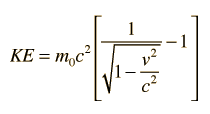
Relativistic Kinetic Energy
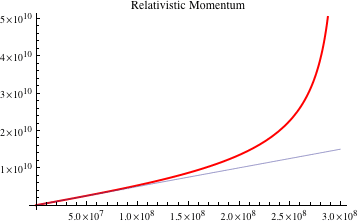
So, instead, I decided, since I knew what specific impulse was from my geek eldest brother, I decided to find out just how much fuel it would take for 190,000 tons of the Enterprise to go from zero to almost the speed of light (.99c) using its impulse drive. I just found the (theoretical) numbers in other books at the library, applied No. 2 pencil to yellow tab paper, plugged in the numbers into the equation for relativistic momentum, and voila!

Imagine my disappointment, when my figures indicated a fuel tank full of liquid hydrogen approximately ten times the volume of the USS Enterprise.

Well, my sixth grade calculations were off just a bit. Really more like a fuel tank a thousand times the volume of the Enterprise. Nevertheless, I was quite disillusioned with the show.

(I think that was also the year I figured a loving personal God was also probably not in the offings as well. At least, no God worth worshiping. But that was done strictly via good old fashioned logic and scholasticism. So, two birds with one stone, basically).

But the graph for relativistic momentum provided me with a new epistemological metaphor for science and technology and truth. See? The closer you get to absolute truth, the harder it gets to get there. That particular mental model stuck with me well through high school, until I got to college.

No, I did not become a postmodern relativist butthead, thank you. I just realized that:

1) There may be no such thing as absolute truth
2) If such a thing exists, the path to it may be not so straightforward and direct
3) There's always going backwards, backtracking, dead ends, blind alleys, and wild goose chases
4) Even if you manage to struggle to the top of one mountain, there's a whole new, much bigger range on the horizon.

Now what do I think about stuff like this?

I think... I think I need a nap.

Monday, November 21, 2011

The Worm and the Thing

- or - Why Buy the Cow When You Can Get the Milk For Free?

I'll just call them Victor (as in Frankenstein). Pardon the nationality mashup, since we don't know who they are, but have a pretty good idea that they are a they and that they are either Russian or Ukrainian (I'm betting Russian).

I call them Victor because they created a monster. It's theirs and they pwn it. They created more than just a monster, though. They created a whole new business model, and it is the wave of the future. And it is brilliant, because they borrowed from the best, the strategy of evolution itself.

In 1938 John Campbell wrote a science fiction novella called "Who Goes There?" Later it was adapted into two movies. The first movie by Howard Hawks, "The Thing From Another World", was considered a science fiction horror movie classic. The second movie, John Carpenter's "The Thing", conforms more to the original story. In Hawks' version, the monster is your standard humanoid monster, ala Frankenstein's monster. In Carpenter's version, it is much more alien, more like the Blob - all consuming, but with that imposter twist - and the accompanying paranoia as to whom to trust.

I've read Campbell's novella, and it scared the hell out me. I'll tell you why. One of the more delicious fears one can have is not fear of death, but fear of lack of control. The alien creature doesn't just consume you. It imitates you. It enslaves you. It mutilates your mind and will, and binds you to service it. The other factor is just the right amount of information. In a horror flick, or in a story, you need just enough information to know that something is a threat, perhaps even an existential threat, but not so much information that you are familiar with the threat. This has always been a problem in movies. How much of the monster do you show? Not enough, and it is all just boring. Too much, and the monster is just another character.

There is a defining scene in Campbell's story when the humans realize that even the tiniest piece of monster can take over an organism. And when one character realizes that their cows have not been monitored against "infection", and that they have all been drinking the milk.
"Mac, how long have the... cows been... not cows?"
 It's a great creepy moment, when he realizes, in a fit of revulsion, hysteria, and self-loathing, that he may be a Thing and not even know it.

So it is with Victor's monster. What is Victor's monster? Well, you may have heard of it. It's called the Conficker Worm. It's a computer worm that was unleashed (as far as we know) back in 2008 or so.

Well, hold on. What's a worm? The term can be traced back to John Brunner's amazingly prescient 1975 science fiction novel "The Shockwave Rider". Brunner envisioned a future world connected by a global "data-net". The data-net, in turn, is controlled by a malevolent corporate-state entity. The protagonist of the story, a hacker named Nick Haflinger, creates a computer program he calls a "tapeworm", which infiltrates the net, takes control over computers, issues orders to replicate itself in still more computers, and, ultimately subverts the data-net, and releases all the nasty crony-capitalist secret files to the public.

Brunner chose to call the program a tapeworm because the viral code consisted of a string of segments that could each reproduce itself onto another computer - another "node" in the net.

The Conficker worm does pretty much that, but without the good intentions. Once this worm infiltrated a computer (yours, perhaps) it would look for others, and continue replicating as far as it could. All of these computers would then link themselves into a "botnet". A botnet is capable of good and bad things. The good witch versions of botnets could also be called "clouds", and they are capable of tremendous data-processing feats that allow complex problems to be solved, or vast amounts of data to be shared and stored. The bad witch version of botnets can be used to launch Denial of Service attacks against websites, or unleash a storm of spam, phish for identity theft, rattle cyberlocks for open doors to steal funds, or flood networks with all sorts of scareware and fraudulent bullshit. If you have enough computers and infiltrated the right systems, you could even, conceivably, disrupt a nation's electronic grid, or banks, or telephones, air traffic, financial markets, health-care systems, or even take down the entire Internet itself.

You could do all those awful things, that is, if you are thinking like a small-time hoodlum, a small-minded one-time blackmailer, a hooligan, a vandal, a stupid barbarian. But then again, for someone smart enough to code something that stymies even the hackers that created the Internet, why would you do that? There is so much more money to be had, power to be accrued, if your botnet is big and stable and lasts for a long, long time.

And there's the brilliant business model. Rather than raise havoc, or rent out access to the botnet to two-bit spammers and scammers, crooks, thieves, and blackmailing fraudsters, you could do a number of other neat things with it. Think of Victor as "ковбой", cowboy, or better still, a cattle baron, his botnet his dairy herd, and the Internet as the Great Plains filled with grass, free for the browsing.

Well, wait, wait, wait a minute, how big of a botnet are we talking about? Well, at one point, it's estimated that Conficker enslaved around 9 million computers, creating quite possibly something approaching the biggest platform on the planet. Oh, companies came up with anti-viral software to purge it, and institutions and businesses have wiped it off of their systems, but actually, it's still around. It's estimated by this guy to average at six and a half million PCs, marshaling a formidable eighteen million CPUs, and capable of generating 28 trillion bytes per second of bandwidth.

That's quite a cloud. The next biggest cloud is Google, with a measly 8% of capacity and processing power. Conficker is not a worm. Not anymore. Conficker is a Thing. A very, very big Thing, and this Thing is never, ever going to go away.

If you wanted to get rid of this Thing, what could you do? Well, create a bigger Thing to smush it, I guess. That's about it. And some people would like to do that, because they feel that this Thing out there represents a threat to freedom of information, and free access, and all that other technocrat-utopian  crystal rainbows and marshmallow unicorns stuff that we all wish would happen.

But it won't happen. That Thing out there? It's not going away. And it's doing stuff. It's processing stuff. It's active. We don't what it's doing, but it's doing something.

Should you be scared? Nah.

If you spent all your time worrying about every existential threat that could befall you, why, you'd be paralyzed into inaction. This is just another annoyance. Or maybe not. Maybe it's just the way the future is. All I know is, unlike the movie "The Thing", this monster chose the respectable route. It lives net door, and, like the Munsters, might not be a good neighbor, but really hasn't done anything to call the cops out.

Victor may let us all know one of these days what kind of Thing he pwns. But I don't think he wants to wreck anything, not while he's making a good living off of it.

Friday, November 18, 2011

The Space Opera Ain't Over 'Til the Fat Alien Sings

Not sure why, but lately, people in Russia have been actively searching for this blog's URL. Not sure what that all that is about, but to my curious Russian friends, I say "Привет!"

I'd say more, but my college Russian is really rusty, and about all I remember now is obscenities and, you know, phrases like: "The pencil is on the table" or "Your sister is very hot".

(Although I am told that my spoken Russian is impressively native-sounding. A big shout-out to my former professors at Indiana University for stressing correct pronunciation).

In the previous essay, in my response to observation on intelligence being the absence of stupidity, Barry queries: "Isn't dark the absence of light?"

A ZPE Formula
Well, you know, Barry, that all was just metaphor, not to mention anthropomorphic metaphor, but, no. No. There is no such thing as dark. If one examines what the emptiest empty is, one finds out that this state is called the Zero Point Energy state.


This can be empirically demonstrated through the Casimir effect. And in fact, a much more dramatic experiment has recently been conducted where light was created out of a vacuum. Sadly, harvesting the Zero Point Energy violates Heisenberg's Uncertainty principle, but this has not stopped bad science fiction scriptwriters or crank inventors from utilizing it.

But you know when it comes to bad science fiction, space opera is up there. I'm not ashamed to admit that I can't enough of that. And I've often considered a realistic space opera story. You know, one that obeys the laws of physics, or at least recognize the established physical limits?

Some say it can't be done. They claim such a story would be boring.

Take the speed of light limit. (Yes, I know, they claim to have broken the light barrier, but I suspect some unknown characteristic about neutrinos that is much more interesting). It eliminates the whole Horatio Hornblower in Space treatment favored by the likes of Star Trek. Difficult to keep the plot moving when it (optimistically) takes decades or centuries to move a scene or episode from one interstellar location to the next. It either calls for a new cast every episode (generation ships), or an immortal - and incredibly patient and persistent - cast of characters.

Is that it? Is that about the only road block to space opera? Well, yeah, within the context of a TV series or a Hollywood movie, yes.

Are there other limits to worry about? Well, perhaps, although it is hard to see how it would affect a story line. Some could put a damper on technological progress for us and any aliens that are out there.

That emptiest empty, that puts the kibosh on free energy.

Coldest cold? Absolute zero. You can only suck so much energy out of something. Again you run into Heisenberg's Uncertainty principle with that, but it still allows you to do cool things with Bose-Einstein condensates, and perform all sorts of optical tricks, possibly for computing (and also living into the bleakness of cold, thin soup era of the universe after the end of the all-too-brief Stellar Age). But effects on space opera? None, I think.

Densest dense? Well, neutron star dense, as far as we know, and applications effected might be for data storage. Although again QM suggests no information is lost in a black hole. In which case the ultimate servers and nodes for the Cosmic Internet are those supermassive black holes at the heart of quasars.

Smallest small? I don't know. Plan on shrinking anything? That plot device really verges more on fantasy, and anyway is of limited dramatic potential. It does put a limit on just fast data can be processed, or how closely something can be scanned. The old teleporter may not need the granular resolution of the Planck length, but that's your strict limit. (And if it turns successful matter transmission requires a scan length/time less than the smallest small, then no beaming down to planets).

Here's one that actually may be important: the hottest hot. Theoretically (depending on who you talk to), you can go all the up to 10 to the 30th degrees kelvin. That's... that's pretty hot. Although practically, you are limited to about 4 billion degrees C before you start to see virtual particle/antiparticle pair creation kick in. This again, if you are needing to transmit something over a small volume or bandwidth, like information or teleported objects, can get into trouble. (If for example, to incorporate all the information, you need a 14 petawatt laser beam confined to .001 millimeter aperture to beam your crew to the surface of a planet, then it, ooh, it gets messy and ugly).

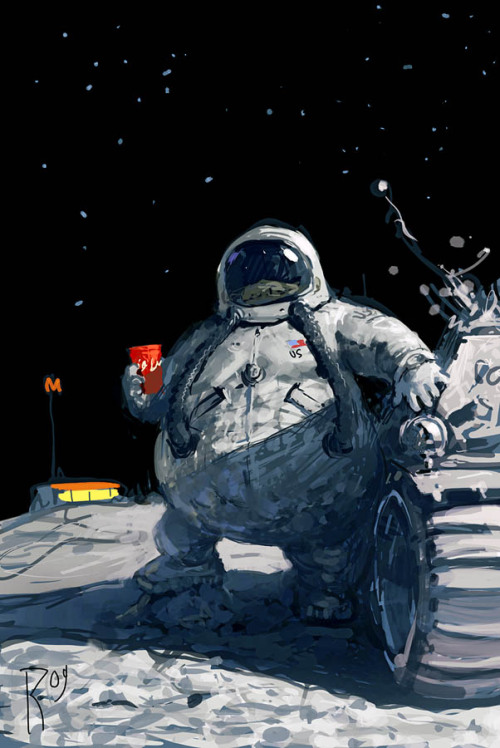
Astrofood by Waldemar von Kozak
On an unrelated note, in keeping with the theme, a British company named Shackelton Energy plans on setting up Moon mines by 2020.  I assume they will want to use robots more extensively than they plan on doing. The idea is to mine the Moon's estimated billions of tons of buried water ice at the poles to manufacture rocket fuel. Presumably, it would be better to wait on that, and consider perhaps that the future may find a wiser use for these one-time resources? No?

Oh well, perhaps by 2020 most people will be too fat to be ferried to the Moon. Americans, at least.


Hah! Stupid, fat, lazy, dumb, stupid, fat Americans! You're fat!