Showing posts with label singularity. Show all posts

Wednesday, June 2, 2010

Cock's Spur on Rye

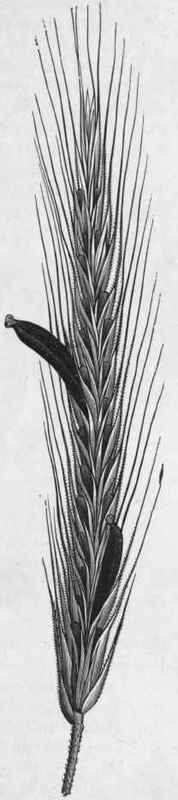
What you are looking at is an ear of rye grass, and the creepy looking rotten banana thing on it is an ergot. The French think it looks like a rooster's spur, and so the title Cock's Spur on Rye. The ergot is a fungal parasite, and replaces a grain of rye. The fungus is called Calviceps purpurea. Until the 1850s, it was assumed that the ergot parasite was part of the rye plant.

Ingestion of ergot causes a condition known as ergotism. In Medieval, and probably ancient times, it was known as the Holy Fire, or St. Anthony's Fire, due to the symptoms of convulsions and painful burning in the extremities. The symptoms were caused by a variety of mycotoxins - toxic alkaloids that the fungus produced. Along with the pain, the toxins produced ghastly hallucinations in practically any animal that ingested it. There are two kinds of poisoning: gangrenous ergotism, in which blood is cut off to the extremities due to constriction of the arteries and capillaries.

Convulsive ergotism is characterized by nervous dysfunction, where the victim is twisting and contorting, trembling, shaking, and experiences wryneck, a more of less fixed twisting of the neck, which seem ot further stimulate convulsions and fits.

Modern pharmaceuticals have been derived from these poisons, including one much abused substance derived from the compound of ergotamine - LSD.

But that's not what I want to talk about. The really creepy thing about this fungus is its lifestyle - how it propagates. I mentioned that it is a parasite, and parasitism in Nature is so pervasive that - if you happen to believe in Intelligent Design - you'd be hard-pressed not to be convinced that the Almighty loves parasites.

The ergot is the nonsexual over-wintering form of the fungus. In the spring, it sprouts stroma, the sexual forms, like little mushrooms, that release the spores. The spores have evolved over time to exactly imitate the pollen of the rye flowers. Once a spore settles down on a rye flower, it destroys and replaces the ovum of the flower, and sends out insidious tendrils into the plant that take over the feeding tubes that would nourish the seeds. Once established, it can also produce a secondary infestation of the ear of rye, by producing honeydew, a sticky, sweet amber liquid that contains asexual clone spores. The honeydew is picked up by insects, which spreads the parasite further.

All in all, just some really, truly, deeply creepy behavior.

Why bring this up? The New York Times recently had an article about the Singularity, found here. They've presented a rather optimistic view of what all will happen, once the Singularity begins, the human age ends, and all bets are off.

I've mentioned in a prior essay that I'm sure we can predict what these superhuman machines, or machine/human hybrids, or who-knows-what will do, because they will now be alive, and likely to repeat all or most of the behaviors of living things.

Well, there you go. This is one behavior. I can find a lot more examples. But I guess you could say I'm lately leaning towards a dystopian view.

Tra-la-la!

Wednesday, November 25, 2009

The Singularity Will Not Be Televised

I googled "Singularity", and received 1,180,000 results in .11 seconds. 

The first result entry was from wikipedia. The second result was from Ray Kurzweil's site. Actually, I should google "technological singularity" to weed out the off-topic subjects, which I do now...

Ah, that's better. I received 106,000 results in .34 seconds. Again, wikipedia is number one. The second site is a philosophical treatment on how to survive a Vingean singularity... by Vernor Vinge. The third result is a google books sample of Ray Kurzweil's "The Singularity is Near". 

Actually, there is something futuristically ironic about what I just done did, as more than likely, Google will be the superhuman intelligence that ushers in the Singularity. (I very much doubt that wikipedia will be the instrument of change - not with the near reactionary fervor of its editors). 

Okay, just what the heck is the Singularity? Well, science fiction authors have given it treatment in one form or another long before it was ever called the Singularity. Usually, the narrative goes something like: 
  1. group of scientists cobble together very large computer brain, and turn it on
  2. said computer brain becomes self-aware, or behaves as if it is (see Turing test)
  3. a) computer brain is many times smarter than the smartest human alive, or b) figures out a physical architecture and software package that is many times smarter than the smartest human alive, and implements it
  4. through the magic of storytelling, the computer brain can make changes to the world through a material instrumentality, because a) by just being so goddamn smart, it attains godlike, or Godlike powers, or b) the group of scientists was dumb enough to connect it to nuclear arsenals or automated facilities, or just does its bidding, or c) the brain figures out how to secretly mail order all the parts it needs to make a giant robot, or some type of gadget that allows it to attain godlike, or Godlike powers, or some such plot driver, and then
  5. the computer brain determines that: a) humanity is a threat to it, or a threat to the planet, or b) humanity is just too damn stupid to be in charge of things, or c) humanity is just too damn stupid, period and therefore:
  6. moving from worst- to best-case scenario... a) humanity is wiped out, or b) computer brain heads out for Parts Unknown, humanity gets left behind literally and figuratively, or c) big brain alters humanity to be less stupid, or at least, much, much nicer.
In short, it is almost a theological scenario where, positing that a superintelligence (God) exists, then It is either malevolent, or indifferent, or beneficent.   

"Yeah, okay. Well, so what?" you say "Isn't this all just some geek adolescent fantasy?"Well, Ray  Kurzweill doesn't think so. People called transhumanists don't. Many philosophers like Nick Bostrom don't. You repeat "Like I said, isn't this all just some geek adolescent fantasy?" Well,... yeah, probably.

But if it isn't, then all bets are off. At least that is what Vernor Vinge says. Vinge is a science fiction author who coined the term "Singularity", or at least made it popular among geeks. Vinge's conundrum is a story-telling one. How can you write about an era of super technology and super intelligence, when things have advanced so far and fast that many things will be beyond human imagination? Isn't that like expecting gerbils to write about nuclear fission? Well, yes, but then it becomes a challenge to writers, and many have accepted it.

Me? I think you can write about the Singularity, simply because we've seen it all before in the history of life on earth. It's all Biology. Want to write about nanotech? Nanotech's been done to death, baby. It is a four billion year old (at least) technology, which occurs every damn day using cellular machinery. Want to know post-Singularity strategies of life and living? Look at all the creepy things bacteria and viruses do. Look at the consortia and cooperatives that unicellular life engages in - not to mention multicellular life.

Is there a place for humans in a post-Singularity world? Is there room for story-telling? I think so. Again look to a history of Life on Earth. There are plenty of creatures that manage to get along without wiping each other out. This particular malevolent fantasy we engage may make for good drama, but it is not very realistic. 

I don't think the future is going to be the immortal heaven that Kurzweil hopes for. In fact, I think that fantasy rather infantile. But I do think there is room for us in it. Certainly room enough for lots of good storytelling.